

The United Nations Office at Geneva
Multimedia Newsroom
Press Conferences | UNHCR , WHO , UNOG , UNITED NATIONS , WFP , WMO , UNECE
UNOG Bi-weekly press briefing 16 April 2021
Clashes in northeast Nigeria
Babar Baloch, for the United Nations Refugee Agency (UNHCR), said the UNHCR was deeply concerned as up to 65,000 Nigerians were on the move following a series of attacks by armed groups on Damasak town, in northeast Nigeria’s restive Borno State. Initial reports indicated that eight people had been killed, and a dozen injured. Up to 80 per cent of the town’s population had been forced to flee. Assailants had looted and burned down private homes, warehouses of humanitarian agencies, a police station, a clinic and a UNHCR Protection Desk.
Mr. Baloch reminded that violence in the Lake Chad Basin had thus far uprooted 3.3 million people, including over 300,000 Nigerian refugees and some 2.2 million displaced within North East Nigeria, especially in Adamawa, Borno and Yobe States.
UNHCR briefing note is available here.
Jens Laerke, for the Office for the Coordination of Humanitarian Affairs (OCHA), added that OCHA continued to receive very worrying reports about clashes between insurgent groups and the Nigerian armed forces. On 10 and 11 April, humanitarian assets had been targeted, and at least five NGO offices and other property had been destroyed. Since 11 April, UN and humanitarian NGO agencies’ activities had been suspended. Many people in the region depended on such assistance to survive, stressed Mr. Laerke. The violent attacks would affect the support to nearly 9,000 internally displaced people and 76,000 people in the host community receiving humanitarian assistance and protection.
It was not always clear who the attackers were, said Mr. Laerke in a response to a question; they were described as “non-state armed groups” or “armed insurgents.” Mr. Baloch added that UNHCR had also had to relocate its staff from Damask because of the insecurity.
Thousands displaced in DRC’s Kasai Region
Babar Baloch, for the United Nations Refugee Agency (UNHCR), said the UNHCR was alarmed by a resurgence of violence in the Democratic Republic of the Congo’s Great Kasai Region, that had already displaced thousands of civilians. According to local authorities, an estimated 21,000 Congolese – mainly women and children – had been displaced since 28 March by clashes between Luba and Kuba ethnic groups in Kasai’s Bakwakenge locality.
There had also been reports of at least 13 people being killed, many left injured and 190 houses burnt to the ground. Tensions between two communities were reported to have been on the rise since August 2020 due to land disputes. Attacks and counter attacks in 2020 had displaced more than 13,000 families - approximately 40,000 people. Many of them had not been able to return to their homes due to fears of reprisals.
Mr. Baloch added that the UNHCR was bringing in emergency supplies including plastic tarpaulins for shelter, mosquito nets, blankets, jerry cans and kitchen sets from the capital, Kinshasa, but the needs are outstripping supplies to help 5,000 families.
There needed to be a renewed effort for reconciliation and establishing law and order, stressed Mr. Baloch while answering a question. There were fears of another mass displacement.
Full briefing note is available here.
Food insecurity in West and Central Africa
Tomson Phiri, for the World Food Programme (WFP), said that millions of families in West and Central Africa were growing more hungry and desperate by the day as food prices skyrocketed, stoking a widening hunger emergency in a region engulfed by conflict and the socio-economic fallout from COVID-19.
More than 31 million people in the region were expected to be food insecure and unable to feed themselves during the coming June-August lean season - the period when food was scarce before the next harvest. That number was more than 30 per cent higher than the previous year. Food prices had increased dramatically across the region. Local staples were up by nearly 40 per cent over the five-year average, and in some areas, prices were up by more than 200 per cent. That was caused in part by the economic impact of measures put in place to contain the spread of the coronavirus over the previous year. People’s incomes had plummeted due to reductions in trade, tourism, informal activities, and remittances.
Mr. Phiri informed that the WFP planned to assist nearly 18 million people in West and Central Africa this year, with 68 per cent of that number being in crisis and emergency response situations. WFP needs USD 770 million in the coming six months for its operations in 19 countries in the region. Failure to raise funds would spell reduced rations for people in need, especially those driven into hunger by conflict.
WFP press release can be read here.
Civilians at risk in Yemen’s Marib
Aikaterini Kitidi, for the United Nations Refugee Agency (UNHCR), stated that the UNHCR was concerned about the safety of civilians as conflict intensified in Yemen’s Marib governorate, as the fighting was increasingly impacting areas in and around Marib city where large numbers of people already displaced by the ongoing conflict were sheltering. In March alone, there had been 40 civilian casualties, including 13 in makeshift settlements for displaced families, the highest number in a month since 2018 in Marib. Airstrikes, shelling and crossfire had also badly damaged civilian infrastructure and property, including informal sites hosting the displaced, water tanks and shelters. Ms. Kitidi said that since the beginning of 2021, the escalation in hostilities had led to the displacement of over 13,600 people in Marib, a region hosting a quarter of Yemen’s four million internally displaced people.
UNHCR was renewing its call on all parties to the conflict to take measures to protect civilians, as well as civilian infrastructure, including sites hosting the displaced. UNHCR was also calling for safe passage for civilians out of the conflict zones, respect for their choice to move to safer areas, and continuing protection for those who may decide to stay behind.
Urgent support was needed from the international community to alleviate the desperate situation of displaced Yemenis who had endured enormous suffering and trauma for the past six years. Only 27 per cent of UNHCR’s funding requirements for the response in Yemen had so far been received, said Ms. Kitidi.
Full briefing note is available here.
Launch of the Global Climate Report
Rhéal LeBlanc, for the United Nations Information Service (UNIS), informed that on 19 April, at 5:30 p.m. Geneva time, United Nations Secretary-General António Guterres and WMO Secretary-General Petteri Taalas would hold a hybrid press conference to present the report on the State of the Global Climate in 2020.
Clare Nullis, for the World Meteorological Organization (WMO), said this was a full report on the state of climate for 2020. This WMO’s flagship report included data from the entire United Nations family, meteorological services and climate experts from around the world. The press conference would be broadcast live; details on how to connect had been shared.
In a response to a question, Ms. Nullis said that 2020 was one of the three warmest years on record.
69th meeting of the UNECE Commission
Jean Rodriguez, for the United Nations Economic Commission for Europe (UNECE), stated that UNECE would host on 20-21 April the sixty-ninth session of the Commission, the highest institutional body of the UNECE. The Commission would set the strategic direction of the work of the organization for the next two years.
The session would also discuss how to promote a Circular Economy and a Sustainable Use of Natural Resources in the region. The extraction of raw materials worldwide had more than doubled since 1990 and could double again by 2060. The 56 countries of the UNECE region were major users and producers of natural resources. Efficiency in the domestic use of resources continued to increase in the region, but the overall material footprint, which included also the raw materials in imported goods, had risen by more than 17 per cent between 2000 and 2017, which had led to environmental degradation and increased vulnerability to climate change.
The high-level segment would be opened by three keynote speakers: Frans Timmermans, Executive Vice-President of the European Commission; Odile Renaud-Basso, new President of the European Bank for Reconstruction and Development; and Børge Brende, President of the World Economic Forum.
More information on the upcoming session is available here.
COVID-19
Fadéla Chaib, for the World Health Organization (WHO), said the Emergency Committee on COVID-19 had held its seventh meeting on 15 April. A full statement was being finalized right now and on 19 April it would be sent to the Member States and the media; it would also be available on the WHO website and discussed at the WHO press conference at 5 p.m. on 19 April.
Responding to questions, Ms. Chaib stressed that front-line health workers, the elderly and those with serious other diseases should be prioritized with vaccination. A summary of the upcoming Fair Pricing Forum would be shared with the journalists, she said.
Geneva announcements
Fadéla Chaib, for the World Health Organization (WHO), informed that 25 April would be World Malaria Day. On that occasion there would be a webinar open to everyone held from 1 to 2:30 p.m. CET on 21 April, followed by a press conference with Dr. Pedro Alonso, Director of the WHO Global Malaria Programme, and Dr. Abdourahmane Diallo, CEO of the RBM Partnership to End Malaria. More details on the event would be shared with the media shortly. A report tracking progress in 21 countries would be presented.
Tomson Phiri, for the World Food Programme (WFP), stated that on 19 April the WFP would be circulating a video news release on how drought, hurricanes, COVID-19 were driving migration from Central America Dry Corridor countries. The material had been collected in Honduras; WFP staff had met with migrants moving in “caravans” through Central America, who spoke to them on their dire situation and the need to migrate.
Rhéal LeBlanc, for the United Nations Information Service (UNIS), said the Committee on the Protection of the Rights of All Migrant Workers and Members of their Families would close its thirty-second session today at 2 p.m.
The Committee on Enforced Disappearances would review the following week the reports of Colombia and Mongolia.
The Committee on the Elimination of Racial Discrimination would open on 19 April at 12:30 p.m. its one hundred and third session online, during which it would review the report of Belgium.
Similar Stories
1
1
1
Press Conferences | UNHCR
End of UNHCR's 77th Annual Executive Committee (ExCom) meeting week
1
1
1
Press Conferences | UNICEF , IOM , UNHCR
UN Special Assistant to the Personal Envoy Office (SUDAN): Peace Initiatives and Efforts in Sudan; UNICEF: Dire situation of children in Gaza; IOM: Damaged Homes and Energy Attacks Risk Displacing Ukrainians for this winter; UNHCR: update on EXCOM week
1
1
1
Press Conferences | IOM , UNDRR
UN stresses importance of household preparedness for disaster risk reduction.
1
1
1
Statements , Press Conferences | OHCHR
1
1
1
Press Conferences | UNHCR , UNICEF , IFRC , OHCHR , UN WOMEN , IOM , OCHA , WHO
UNHCR – ExCom Meeting, UNICEF – Nepal Recovery, IFRC – Flash Floods, WHO – Mental Health, IOM – South Sudan Floods, OCHA – DRC Humanitarian aid, UNHCR – Sahel Displacement, UNICEF – Yemen Update, IOM – Gaza Shelter, UN Women – Gaza Women, OHCHR – Arrests and detentions of Syrians by Israeli force
2
1
2
Press Conferences | UNCTAD
Presentation of the Trade and Developement Report 2026
Embargoed until 9 October 2026 at 11 a.m. (Geneva Time)
UNCTAD: UNCTAD’s flagship report finds that governments increasingly use industrial, trade, financial and technology policies to pursue economic and national security objectives. Market access and the ability to move into higher-value activities now depend more heavily on technology, finance and geopolitics.
1
1
1
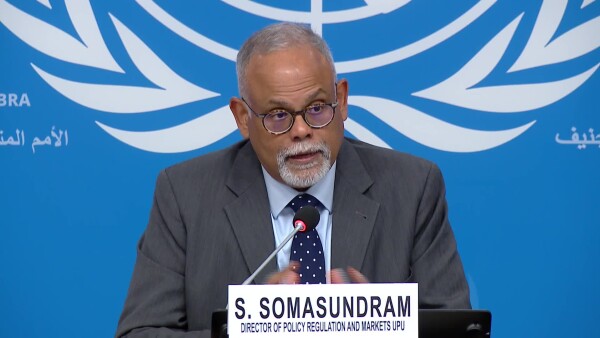
Press Conferences | UPU
Release of the State of the Postal Sector Report 2026
1
1
1
Press Conferences | IOM , ITU , UNECE , UNICEF , WHO , WMO
UNICEF: Ebola, DRC - children orphans or separating them from parents and caregivers; IOM: Humanitarian needs in Djibouti amid arrivals from Yemen and increased migrant movements; WHO: Darfur, scale of health needs far exceeds available resources; WMO co-sponsored Global Heat Forum, Bangkok, monthly Global Seasonal Climate Update; UNECE: UN Forum of Mayors; ITU Plenipotentiary Conference 2026; WHO: child and adolescent obesity guidelines and new global roadmap to tackle pregnancy hypertension, a leading cause of maternal mortality
1
1
1
Press Conferences | OCHA , UN WOMEN , UNHCR , WFP , WHO , WTO , UNEP
OCHA – $160M CERF allocation to 12 underfunded crises; UNHCR – 5.8M refugee children remain out of school amid funding cuts; UN Women – Middle East escalation and food security among women/girls; WHO – Gaza supplies and overall situation; WFP – Yemen food insecurity and impact on global hunger ; UNEP - First International Conference of the Global Framework on Chemicals in Geneva | 16-20 November 2026
1
1
1
Press Conferences | UNHCR , WHO
Yemen's health system nears collapse amid conflict, causing rising casualties and medicine shortages.
1
1
1
Press Conferences | HRC
Update by the Expert Mechanism to Advance Racial Justice and Equality in Law Enforcement
1
1
1
Press Conferences | WIPO , WHO , UNICEF , UNHCR , IOM , WFP , FAO
WIPO Global Innovation Index 2026 launch and press conference, WHO Composition of influenza vaccines for the 2027 Southern Hemisphere flu season, UNICEF Yemen hunger and malnutrition; UNHCR Sudan displacement into Chad; IOM Ebola and population movements in DRC; WFP emergency food assistance in Nepal; and FAO food loss and waste.