

The United Nations Office at Geneva
Multimedia Newsroom
Press Conferences | OHCHR , OCHA , UNOG , UNITED NATIONS , WFP
UNOG Bi-weekly press briefing 24 November 2020
2020 Afghanistan Conference
Alessandra Vellucci, for the United Nations Information Service (UNIS), said that the Secretary-General of the United Nations, António Guterres, had addressed the Afghanistan Conference by video message. He had urged the redoubling of efforts towards an immediate, unconditional ceasefire, in order to save lives and prevent the further spread of COVID-19. This would create a conducive environment for the Afghanistan Peace Negotiations in Doha—a major opportunity to realize the long-held aspirations of the Afghan people. The United Nations stood with the people of Afghanistan on the path towards
peace, development and self-reliance. The Secretary-General had thanked all donors for their pledges and generosity. “Let’s make sure that these translate into real progress and concrete improvements for the people of Afghanistan,” he had added.
Ms. Vellucci added that the 2020 Afghanistan Peace Conference would hold a readout today at 2 p.m. with the following speakers: Pekka Haavisto, Minister of Foreign Affairs, Government of Finland; Deborah Lyons, Special Representative of the Secretary-General and Head of the United Nations Assistance Mission for Afghanistan (UNAMA); and Abdul Hadi Arghandiwal, Minister of Finance, Government of Afghanistan [later it was confirmed that the speaker for the Afghan government would be the Deputy Minister of Finance, Abdul Habib Zadran]. The readout would take place in Room XIV and would be webcast.
At 6:30 p.m., the 2020 Afghanistan Peace Conference would hold a hybrid press conference. The following speakers would take part: Abdul Hadi Arghandiwal, Minister of Finance, Government of Afghanistan; Pekka Haavisto, Minister of Foreign Affairs, Government of Finland; Ville Skinnari, Minister for Development Cooperation and Foreign Trade, Government of Finland; and Deborah Lyons, Special Representative of the UN Secretary-General and Head of the UN Assistance Mission in Afghanistan.
Food security situation in Afghanistan
Tomson Phiri, for the World Food Programme (WFP), said Afghanistan was facing extremely high levels of food insecurity and malnutrition. An estimated 16.9 million people equivalent to 42 per cent of the total population were facing acute food insecurity levels (IPC Phase 3 + 4). This was 4.5 million more people in need than before the pandemic hit the country. The socio-economic impact of the COVID-19 pandemic in Afghanistan was even more devastating than the disease itself, with a far-reaching impact on the food security of communities that would last far into the coming year. The humanitarian situation across all sectors could further deteriorate in the coming months, driven by political uncertainty and extreme levels of violence. WFP was planning to increase the number of people to assist in 2021 to 13 million and required US$460 million to do so.
Situation in Tigray and Ethiopia
Alessandra Vellucci, for the United Nations Information Service (UNIS), said the United Nations remained extremely concerned about the safety of civilians in the Tigray Region, especially the more than half a million people—including more than 200 aid workers—who remained in Mekelle following information that fighting might move into the city in the coming hours. The United Nations and its humanitarian partners in Ethiopia were urgently calling on all parties to the conflict to comply with their obligations under international humanitarian law and protect civilians and civilian infrastructure, including health facilities and water systems.
Jens Laerke, for the Office for the Coordination of Humanitarian Affairs (OCHA), said it was urgent that all parties to the conflict enable the free and safe movement of all civilians in search of safety and assistance including across both international and national borders. The United Nations and humanitarian partners in Ethiopia were ready to provide assistance to people affected by the conflict. To do this, safe, free and unhindered humanitarian access was urgently needed. OCHA had finalized a humanitarian preparedness plan intended to help two million people with assistance in Tigray, Afar and Amhara regions that included existing humanitarian caseloads that OCHA was already helping, and an additional 1.1 million people expected to be in need of assistance as a result of this conflict. About US$76 million were needed to finance this plan.
Babar Baloch, for the United Nations High Commissioner for Refugees (UNHCR), said that the number of Ethiopian refugees streaming into eastern Sudan had now surpassed 40,000 since the crisis began, with more than 5,000 women, children and men fleeing the ongoing fighting in the Tigray region over the weekend. UNHCR and its partners had been able to deliver and distribute lifesaving aid, including food, to more people. But the humanitarian response continued to face logistical challenges and remains overstretched. There was not enough shelter capacity to meet the growing needs. Inside Ethiopia, UNHCR remained concerned about civilians, including displaced populations and aid workers in Tigray. UNHCR joined its United Nations partners in calling on all parties to the conflict to comply with their international obligations to protect civilians. It reiterated its call for free, safe and unhindered humanitarian access so that humanitarian assistance could reach people that relied on it.
A full briefing note is available here.
Tomson Phiri, for the World Food Programme (WFP), said WFP was alarmed at growing numbers of people in need of humanitarian assistance in both Ethiopia and Sudan because of the conflict in the Tigray region of Northern Ethiopia. On Sudan’s border with Ethiopia, the humanitarian situation was rapidly deteriorating as the influx of people continued. Needs remained very high and would likely overwhelm the response. WFP was providing food and logistics support together with United Nations agencies, the Sudanese Government and local partners. WFP had dispatched enough food to feed 60,000 people for one month. However, the food had had to be borrowed from ongoing programmes elsewhere in the country. Continued influx of new arrivals would strain WFP’s ability to respond to existing humanitarian needs in Sudan as it dealt with multiple crises throughout the country. WFP was appealing for US$24.6 million to meet the immediate needs of Ethiopian refugees seeking safety in Sudan.
Ravina Shamdasani, for the Office of the High Commissioner for Human Rights (OHCHR), said the United Nations High Commissioner for Human Rights Michelle Bachelet on Tuesday had said, “The highly aggressive rhetoric on both sides regarding the fight for Mekelle is dangerously provocative and risks placing already vulnerable and frightened civilians in grave danger.” “I fear such rhetoric will lead to further violations of international humanitarian law,” the High Commissioner had added, expressing alarm at reports of a heavy build-up of tanks and artillery around Mekelle, the capital of Tigray province following the Government’s issuance of a 72-hour ultimatum. “Such rhetoric suggests possible breaches of the cardinal principles of distinction, proportionality and precaution in the conduct of hostilities that are designed to ensure the civilian population is protected.”
A full press release is available here.
Mr. Laerke said negotiations on access were ongoing, and OCHA was seeking unhindered access to Tigray to provide assistance. Because of a communications blackout, OCHA could not assess the number of internally displaced people. However, it should be noted that prior to crossing the border, refugees were internally displaced. Therefore, on the basis of the number of refugees, OHCHA was very concerned about the scale of internal displacement.
Mr. Baloch said about half—that is 45 per cent—of refugees were children. The daily number of refugee arrivals had almost reached 3,000 people.
Ms. Shamdasani said OHCHR had an office in Addis Ababa, and was in contact with the authorities. The principles of proportionality and distinction between civilians and military objectives had to be upheld. The High Commissioner had called for the authorities to give clear and unambiguous orders to security forces to take constant care to protect the civilian population.
Racism and discrimination in Brazil
Ravina Shamdasani, for the Office of the High Commissioner for Human Rights (OHCHR), said the killing of João Alberto Silveira Freitas, an Afro-descendent beaten to death by two private security guards in the southern Brazilian city of Porto Alegre, was an extreme but sadly all too common example of the violence suffered by Black people in Brazil. The structural racism, discrimination and violence people of African descent faced in Brazil was documented by official data. Noting that an investigation was underway regarding the death of Mr. Silveira Freitas, Ms. Shamdasani said it should be prompt, thorough, independent, impartial and transparent, and should also examine if racial bias played a role. This aspect should also be considered when ensuring justice and truth, as well as redress and reparations for his family. OHCHR was calling on the authorities to investigate any allegations of unnecessary and disproportionate use of force against people protesting peacefully following Silveira Freitas’s death, and hold those responsible to account.
Responding to questions, Ms. Shamdasani said this deplorable act should be condemned by everyone. Government officials have a particular responsibility to acknowledge the underlying problem of the persisting racism in the country, as this was the first essential step towards solving this problem. This responsibility also extended to private enterprises, which had an obligation to conduct due diligence.
Geneva Announcements
Christine Loew, for United Nations Entity for Gender Equality and the Empowerment of Women (UN Women), said the United Nations system’s campaign for 16 Days of Activism against Gender-Based Violence would kick off tomorrow, on the International Day for the Elimination of Violence against Women, and run until 10 December, Human Rights Day. This year, it would take place under the global theme: “Orange the World: Fund, Respond, Prevent, Collect!” In Geneva, UN Women and the European Union Delegation to the United Nations had collaborated on a public transport ad campaign, highlighting the need to end Elimination of Violence against Women and “oranging” TPG buses and trams throughout the city. The UN Office at Geneva would lit up the Palais des Nations, and the jet d’eau would also turn orange tomorrow in commemoration of the International Day for the Elimination of Violence against Women.
Alessandra Vellucci, for the United Nations Information Service (UNIS), said that, today at 3:30 p.m., the World Health Organization (WHO) would hold a press conference to launch the new physical activity guidelines. Speakers would be Dr. Ruediger Krech, Director for Health Promotion, World Health Organization; Dr. Fiona Bull, Unit head, Physical Activity, World Health Organization; and Juana Willumsen, Technical Officer, Physical Activity, World Health Organization.
Tomorrow, on Wednesday 25 November at 9:30 a.m. United Nations Institute for Disarmament Research (UNIDIR) would hold a press conference to launch the Cluster Munition Monitor 2020 Report. Speakers would be Mary Wareham, Advocacy Director, Human Rights Watch, Arms Division; Loren Persi, Impact research team leader, ICBL-CMC; and Ruth Bottomley, Research specialist, expert on contamination, clearance and risk education, ICBL-CMC.
On Friday, 27 November, at 3:30 p.m., the Office of the High Commissioner for Human Rights would hold a press conference on the Global Humanitarian Overview 2021, with Mark Lowcock, United Nations Under-Secretary-General for Humanitarian Affairs and Emergency Relief Coordinator. All material would be under strict embargo until Tuesday, 1 December at 6 am CET/05.00 GMT.
The Committee on the Elimination of Racial Discrimination, which opened last week its virtual 102nd session, would close its session today at 4 p.m.
Similar Stories
1
1
1
Press Conferences | UN WOMEN , WFP , WHO
UN WOMEN: Sudan Women and girls one year after the fall of El Fasher; increasing drone attacks across the country; WFP: DRC - Ebola spreads to eighth DRC province as WFP delivers food, builds treatment centres and keeps supplies moving; WHO - Update on Ebola (Bundibugyo Virus Disease)
1
12
1
1
Press Conferences , Images | UNOG
Closing Press Conference following the Sixth Consultative Meeting on Enhancing Coordination of Peace Initiatives and Efforts in Sudan

2
17
1
2
Edited News , Press Conferences , Images | OCHA , WMO
Two UN agencies teamed up on Wednesday to issue an appeal for immediate assistance to help communities already being impacted by the strongest El Niño on record.
1
1
1
Press Conferences | CITES
Wildlife trade and conservation policy discussions at the 81st meeting of the CITES Standing Committee (SC81)
1
1
1
Press Conferences | UNHCR , UNCTAD , WMO , OCHA , UNICEF , WHO
UNHCR Hungary’s 1956 Refugee Crisis: 70 Years On, UNCTAD World Investment Forum 2026, Doha, WMO Greenhouse Gas Bulletin and Climate Update for COP31, OCHA Afghanistan: Malnutrition, Girls’ Education and Recovery, UNICEF Yemen: Child Malnutrition and Unsafe Water in Taiz, WHO Inequalities in Noncommunicable Diseases and Risk Factors

1
1
1
Press Conferences | UNHCR
End of UNHCR's 77th Annual Executive Committee (ExCom) meeting week

1
1
1
Press Conferences | UNICEF , IOM , UNHCR
UN Special Assistant to the Personal Envoy Office (SUDAN): Peace Initiatives and Efforts in Sudan; UNICEF: Dire situation of children in Gaza; IOM: Damaged Homes and Energy Attacks Risk Displacing Ukrainians for this winter; UNHCR: update on EXCOM week

1
1
1
Press Conferences | IOM , UNDRR
UN stresses importance of household preparedness for disaster risk reduction.

1
1
1
Statements , Press Conferences | OHCHR
1
1
1
Press Conferences | UNHCR , UNICEF , IFRC , OHCHR , UN WOMEN , IOM , OCHA , WHO
UNHCR – ExCom Meeting, UNICEF – Nepal Recovery, IFRC – Flash Floods, WHO – Mental Health, IOM – South Sudan Floods, OCHA – DRC Humanitarian aid, UNHCR – Sahel Displacement, UNICEF – Yemen Update, IOM – Gaza Shelter, UN Women – Gaza Women, OHCHR – Arrests and detentions of Syrians by Israeli force
2
1
2
Press Conferences | UNCTAD
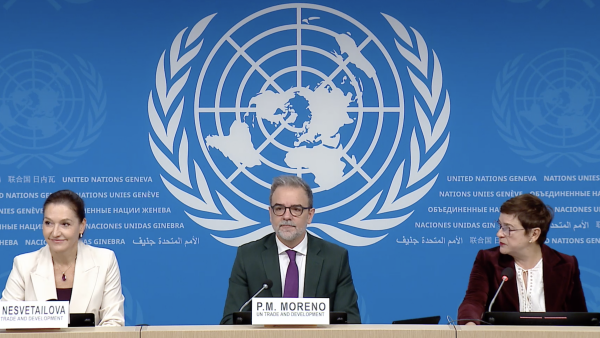
Presentation of the Trade and Developement Report 2026
Embargoed until 9 October 2026 at 11 a.m. (Geneva Time)
UNCTAD: UNCTAD’s flagship report finds that governments increasingly use industrial, trade, financial and technology policies to pursue economic and national security objectives. Market access and the ability to move into higher-value activities now depend more heavily on technology, finance and geopolitics.
1
1
1
Press Conferences | UPU
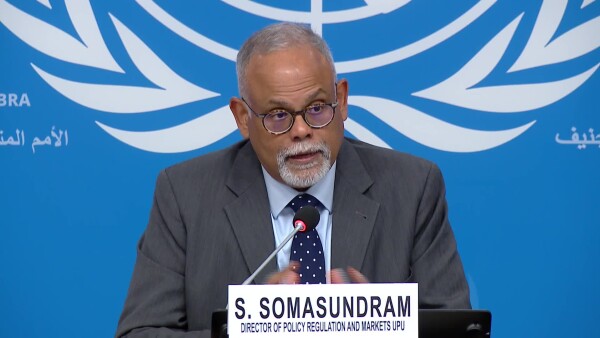
Release of the State of the Postal Sector Report 2026