

The United Nations Office at Geneva
Multimedia Newsroom
Press Conferences | WFP , UNHCR , WHO , IOM , UNFPA
UN Geneva Press Briefing - 12 December 2025
UN INFORMATION SERVICE GENEVA PRESS BRIEFING
12 December
UNHCR 2025 Nansen Refugee Award Winner
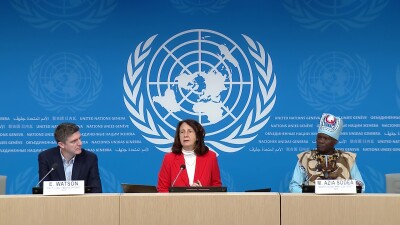
Ewan Watson, Head of the Global Communication Service at the UN Refugee Agency (UNHCR), said that more than 117 million people remained forcibly displaced globally, having fled their homes to escape war, persecution or violence. The promise of the 1951 Refugee Convention was under threat, in a context where xenophobia was on the rise, displacement was now more complex and long-lasting, peace was harder to reach, and funding gaps were decimating essential programs: humanitarian funding for UNHCR had been slashed by 35 percent this year, leaving millions without access to safety, food, shelter and vital protection services.
However, beyond the noise, communities everywhere were still standing by refugees, with volunteers greeting families at airports, teachers finding space in classrooms, neighbors opening their doors, companies offering jobs, universities providing scholarships. The power of local people who helped those who found themselves, through no fault of their own, reliant on others, demonstrated that solutions did exist. Ordinary people were doing extraordinary things, proving that “humanity wins over hate”.
In this regard, Mr. Watson introduced Martin Azia Sodea, 2025 UNHCR global Nansen Refugee Award laureate, and current chief of Gado-Badzéré, a village in East Cameroon. Mr. Azia Sodea said he was proud of being part of a tribe whose custom was to avoid conflict and save human lives, as well as receive strangers in distress and share with them whatever they needed. As such, the population of his village – 12,000 inhabitants – had received, over the years, some 36,000 refugees fleeing death and violence in Central African Republic. These refugees had received food, clothes and even land, and their children had shared the same schools as the locals. The village had also provided UNHCR with 60 hectares to build a camp. Today, it was impossible to distinguish between the camp and the village. Traditional governments, traditional chieftains, international organizations and donors in the world, all must open their doors to refugees in distress and save their lives before asking questions.
Answering questions from the media, Mr. Azia Sodea stressed that it was necessary first to provide refugees with food and health, and second to empower them to support themselves, especially in agriculture. Their children must be sent to schools.
In response to a question on the next High Commissioner for Refugees, Alessandra Vellucci, for the UN Information Service, explained that the proper process of choosing the new High Commissioner for Refugees – to succeed Filippo Grandi – included consultations with the Executive Committee of UNHCR before a decision by the General Assembly in New York.
World Food Programme: Update on Sudan
Ross Smith, Director of Emergency Preparedness and Response at the World Food Programme (WFP), speaking from Rome, said that after more than a year and a half under siege, the essentials for survival have been obliterated in El Fasher: markets had been destroyed, healthcare facilities decimated, and basic services wiped out. Satellite images and survivor accounts described El Fasher as a “crime scene”, with mass killings and burned bodies. Leaving the city was extremely dangerous: there were risks of robbery, looting and violence against women and girls, and the city and its surrounding roads were littered with mines and unexploded ordnance.
WFP was helping the displaced persons whenever possible, but as people were on the move, reaching them remained a big logistical and operational challenge. WFP was calling for unimpeded access into El Fasher to respond to the needs of those who remained trapped in the city; it had an agreement in principle with the Rapid Support Forces for a set of minimum conditions for the UN to enter the city.
Furthermore, over 650,000 people had sought safety in Tawila, a small town in North Darfur. First came families fleeing from Zamzam IDP camp in April 2025. Now more people were arriving from El Fasher: these were families who had endured famine and mass atrocities and were now living in overcrowded conditions, cholera being widespread. WFP was providing food, but there was no healthcare, no sanitation, and very limited humanitarian support.
WFP was also deeply concerned about escalating violence in the Kordofan region, particularly in Kadugli. Preventing the devastation seen in El Fasher from repeating in Kadugli must be a priority. With frontlines now concentrated in Kordofan, each clash forced more families to flee, compounding humanitarian needs at a time when resources were already stretched thin.
Operational gains made by WFP over the past year were at risk. The Programme warned of drastic ration cuts starting in 2026. To maintain current levels of assistance, beginning in January, rations would be reduced to 70 percent for communities in famine areas and 50 percent for those at risk of famine: this was the absolute minimum for survival. Even with these measures, WFP only had resources to sustain current support for four months. Some USD 695 million were urgently required over the next six months to keep the hunger crisis from spiraling out of control.
Answering questions, Mr. Smith said that funding was the primary challenge; logistics and getting approvals also took a long time. Rations would be cut starting in January to stretch the resources until April, when funding would “fall off a cliff”, he warned.
Illnesses, Infections and Storms: Gazans Facing Another Harsh Winter
Dr. Rik Peeperkorn, Representative in the occupied Palestinian territory for the World Health Programme (WHO), speaking from Gaza, explained that 18 out of 36 hospitals and 43 percent of primary health-care centers in Gaza were partially functioning – for instance, despite immense challenges, Shifa Hospital in Gaza City was working again as a partially functional tertiary care hospital, with many services now functional.
On the other hand, there was no MRI available in Gaza and only two CT scanners to cover a population of over two million. There was also a severe shortage of essential medicines and medical supplies needed for, among other things, heart disease treatment, kidney transplantation and hemodialysis, and intensive care surgery. Although approval rates for supplies had improved, the process of getting medicines and medical equipment into Gaza remained unnecessarily slow and complex.
WHO also faced challenges in bringing laboratory reagents and critical lab machine components into Gaza, as many items were denied entry because of being classified as “dual use”. Medical supplies must be given a blanket approval to enter Gaza and be expedited so urgent needs could be addressed.
It was in this context that Storm Byron had struck Gaza, deepening the suffering of already displaced families. Thousands of them were sheltering in coastal areas with no drainage or protective barriers. Along the Khan Younis shoreline alone, more than 4,000 people were living in high-risk zones. At least ten people had reportedly died in the past 24 hours due to heavy rains; there also had been reports of two babies or children under five having died from hypothermia this week.
Winter conditions, combined with poor water and sanitation, were expected to drive a surge in acute respiratory infections, hepatitis and diarrheal diseases. Children, older people, and those with chronic illnesses remained at greatest risk. This winter, WHO was working to help keep newborns, children, and mothers warm and safe in hospitals. WHO was also supplying breastfeeding support items and materials for skin-to-skin care to protect pre-term and low-birth-weight infants during the harsh winter months.
According to Ministry of Health records, 1,092 patients had died while awaiting medical evacuation between July 2024 and 28 November 2025. This figure was likely underreported and not fully representative, as it was based solely on reported deaths. More than 18,500 patients (including 4,096 children) in Gaza still needed medical evacuation. WHO called on more countries to welcome patients from Gaza, and for medical evacuation to the West Bank, including East Jerusalem, to be restored.
Answering questions, Dr Peeperkorn expressed concern that, in the winter and with poor shelter conditions, children under five would be particularly exposed to acute respiratory infections, including pneumonia, and diarrheal diseases. Dr. Peeperkorn pointed to shortages in medicines, surgery equipment, and medical imaging. He also stressed that more than a quarter of the 70,000 Gazans who had been injured would need lifelong assistive technology. According to UNICEF, 82 children had been killed since 10 October, he noted.
Dr. Peeperkorn said he had been working for WHO in the region since March 2021. During the crisis, the health system and services had, somehow, remained at least partially functional — a credit to the health workers, the Ministry of Health, and WHO. This resilience had come at an enormous material and human cost, including for WHO. Dr. Peeperkorn emphasized both the quality of the health staff on the ground and their ingenuity in overcoming shortages.
Measles Outbreak in South Carolina
Christian Lindmeier, for the World Health Organization, answered a question regarding the measles outbreak in South Carolina (USA). Mr. Lindmeier explained that measles was a very contagious, vaccine-preventable disease, and that WHO stood ready for any support Member States might request.
IOM’s Cyclone Response in Sri Lanka.
Kristin Parco, Chief of Mission in Sri Lanka for the International Organization for Migration (IOM), speaking from Colombo, said the people of Sri Lanka had not seen, in years, such widespread destruction as sowed by Cyclone Ditwah. The scale of the emergency was overwhelming: over 280,000 people were now internally displaced, with their homes destroyed.
IOM had begun its response by distributing urgent relief supplies to families in the Northern, Eastern, Western, and Central provinces. Communities remained in desperate need of shelter, clean water, and access to basic health care and psychosocial support. IOM had deployed its Displacement Tracking Matrix across 25 districts, to collect accurate, real-time data on displacement and returns. It was expanding operations to reach the most affected communities in the Uva, Central and Western Provinces.
IOM was launching its appeal for the cyclone response and required USD 7.3 million to sustain and scale up life-saving interventions in the coming months. Without immediate support, there was a risk of losing the window to prevent further suffering and loss. More information was to be found on the IOM’s donor website.
UNFPA's 2026 Global Humanitarian Appeal to Safeguard the Health and Rights of Women and Girls in Crisis Settings
Eugene Kongnyuy, Deputy Director of the Humanitarian Response Division at the United Nations Population Fund (UNFPA), said the Fund had launched, on 11 December, its 2026 Humanitarian Appeal with a stark message: women and girls in crisis settings were entering 2026 facing greater danger and a shrinking humanitarian lifeline. In this context UNFPA priorities were to ensure that no woman should die giving birth, no pregnancy should be unwanted, that every girl and woman should be free of violence, and that if there was violence, a survivor should have the services they needed.
UNFPA estimated that, in 2026, 7.7 million pregnant women would need humanitarian assistance, and 80 million women and girls would require services for gender-based violence. Meeting these needs had become increasingly difficult. Last year UNFPA had launched an appeal of USD 1.2 billion: only 39 percent of it had been funded. At least 10 to 12 million women and girls stood to lose essential services in 2025-2026 if the current gap were to persist, including 6.3 million in Afghanistan, two million in Yemen, 1,6 million in Myanmar and hundreds of thousands more on Central African Republic, Lebanon, Somalia, Sudan, Syria and Libya.
As the humanitarian system was shifting, in 2026 UNFPA would appeal for nearly USD 1 billion to deliver life-saving sexual and reproductive health services, gender-based violence services across 42 crisis affected countries. The appeal was smaller and more focused than in previous years: this reflected a different prioritization in the system, not a decline in needs.
Announcements (noted following the briefing)
The Director-General of the UN Office at Geneva, Tatiana Valovaya, would brief the press at 10 am on 16 December, ahead of the regular press briefing.
There will be no human rights treaty body meeting until 12 January, when the Committee on the Rights of the Child (CRC) should open its 100th session.
The last UNOG press briefing of 2025 will be held on 19 December, with briefings then resuming on 6 January 2026.
***
TOPICS:
-
WFP - Ross Smith, WFP Director of Emergency Preparedness and Response - Latest developments in Sudan; urgent needs, increasing risk of further displacement, WFP operations and continuing challenges
- UNHCR - Matthew Saltmarsh with Ewan Watson, UNHCR Head of Global Communication Service & Martin Azia Sodea, UNHCR Nansen Refugee Award winner (Global Laureate) - The global Nansen Refugee Award winner
- WHO - Christian Lindmeier with Dr Rik Peeperkorn, WHO Representative in the occupied Palestinian territory - Illnesses, infections and storms - Gazans facing another harsh winter
- IOM - Kristin Parco, IOM Chief of Mission in Sri Lanka - Update on IOM’s Cyclone response in Sri Lanka.
- UNFPA - Eugene Kongnyuy, Deputy Director of UNFPA’s Humanitarian Response Division - Launch of UNFPA's 2026 global humanitarian appeal to safeguard the health and rights of women and girls in crisis settings
Similar Stories
1
1
1
Press Conferences | IOM , ITU , UNECE , UNICEF , WHO , WMO
UNICEF: Ebola, DRC - children orphans or separating them from parents and caregivers; IOM: Humanitarian needs in Djibouti amid arrivals from Yemen and increased migrant movements; WHO: Darfur, scale of health needs far exceeds available resources; WMO co-sponsored Global Heat Forum, Bangkok, monthly Global Seasonal Climate Update; UNECE: UN Forum of Mayors; ITU Plenipotentiary Conference 2026; WHO: child and adolescent obesity guidelines and new global roadmap to tackle pregnancy hypertension, a leading cause of maternal mortality
1
1
1
Press Conferences | OCHA , UN WOMEN , UNHCR , WFP , WHO , WTO , UNEP
OCHA – $160M CERF allocation to 12 underfunded crises; UNHCR – 5.8M refugee children remain out of school amid funding cuts; UN Women – Middle East escalation and food security among women/girls; WHO – Gaza supplies and overall situation; WFP – Yemen food insecurity and impact on global hunger ; UNEP - First International Conference of the Global Framework on Chemicals in Geneva | 16-20 November 2026
1
1
1
Press Conferences | UNHCR , WHO
Yemen's health system nears collapse amid conflict, causing rising casualties and medicine shortages.
1
1
1
Press Conferences | HRC
Update by the Expert Mechanism to Advance Racial Justice and Equality in Law Enforcement
1
1
1
Press Conferences | WIPO , WHO , UNICEF , UNHCR , IOM , WFP , FAO
WIPO Global Innovation Index 2026 launch and press conference, WHO Composition of influenza vaccines for the 2027 Southern Hemisphere flu season, UNICEF Yemen hunger and malnutrition; UNHCR Sudan displacement into Chad; IOM Ebola and population movements in DRC; WFP emergency food assistance in Nepal; and FAO food loss and waste.
2
1
2
Press Conferences | UNCTAD
Gaza reconstruction needs reach $71.5 billion as Palestinian economy and public finances face severe strain. Latest UNCTAD report documents the loss of decades of development gains, economic collapse in Gaza and tightening economic constraints in the West Bank.
The report identifies three immediate priorities: transferring withheld Palestinian revenues, safeguarding the banking system and aligning reconstruction support with the documented scale of damage and economic losses.
1
1
1
Press Conferences | HRC
Press conference on the situation of human rights in Nicaragua by the UN Group of Human Rights Experts
1
1
1
Press Conferences | ITU , UNHCR , WHO , WMO
YEMEN - UNHCR: Escalating conflict in Yemen could fuel more displacement, refugee movement
CLIMATE - WHO / WMO: Health and Climate impact of El Niño
1
1
1
Press Conferences | HRC , OHCHR
Mariana Katzarova discusses human rights in Russia as a UN Special Rapporteur.
1
1
1
Press Conferences | IOM , OHCHR , UN WOMEN , UNFPA , UNHCR , UNOPS , WHO
UN Geneva briefing: Yemen crisis worsens, urgent aid needed across multiple sectors.
1
1
1
Press Conferences | HRC
Press conference on the latest report of the Independent International Fact-Finding Mission on the Bolivarian Republic of Venezuela to the UN Human Rights Council
1
1
1
Press Conferences | OHCHR
Victims Still Waiting: A Global Briefing on Transitional Justice Around the World