

The United Nations Office at Geneva
Multimedia Newsroom
UN GENEVA PRESS BRIEFING
3 October 2025
Situation in Gaza
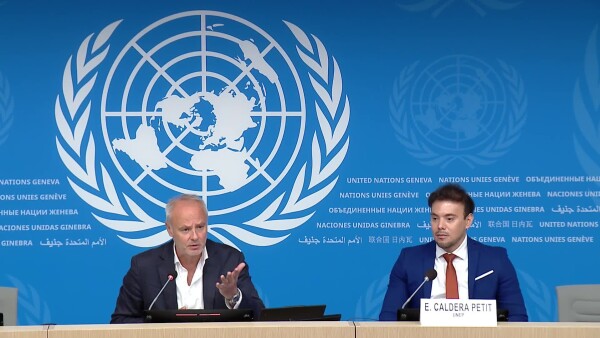
James Elder, for the United Nations Children’s Fund (UNICEF), speaking from Gaza, said that Gaza City remained home to tens of thousands of children, under dire circumstances and relentless air strikes. “Where can we go that is safe?” was the question Mr. Elder heard over and over again in Gaza City. Dozens of children were being admitted to hospitals for malnutrition and injuries every day. The evacuation orders did not mean that those who stayed behind could be legitimate targets, stressed Mr. Elder. Some 85 percent of families in the crowded southern areas now lived in the vicinity of open sewage areas. The notion of the safe zone in the south was farcical, with many so-called “safe zones” regularly reduced to rubble. In Al Nasser Hospital, Mr. Elder had seen children paralyzed and burned by direct air hits, as well as children hit by quadcopters.
Something was profoundly broken in the international system when such a situation was being tolerated. The situation for mothers and newborns in Gaza was never worse, with mothers and their babies lying on the floors of hospitals, and a number of premature babies sharing one oxygen bottle. Reports showed that a thousand babies had been killed in Gaza over the past two years; it was not known how many had died of infectious, preventable diseases. Mr. Elder said that UNICEF had continuously reported on the war on children, polio outbreaks, and starvation. The situation was now worse than ever, and Palestinian boys and girls were still paying the highest price.
Dr. Richard Peeperkorn, World Health Organization (WHO) representative in the occupied Palestinian territories, also speaking from Gaza, stated that the WHO had estimated life-changing injuries counted for one quarter of all reported injuries. Some 42,000 people had life-changing injuries; of them 10,000 children. Some 5,000 people had had to have amputations, informed Dr. Peeperkorn. There was a growing prevalence of facial and eye injuries, for which the shaken health system was inadequate. Many of the pre-war therapists had been displaced, and there was hardly any manufacturing for artificial limbs. Such heavy bodily injuries carried a grave mental health toll as well. There was a need for urgent protection of health care, stressed Dr. Peeperkorn. Only 14 of Gaza’s 36 hospitals remained partially functional, while less than one-third of pre-conflict rehabilitation services were operating.
He said that eight hospitals remained partially functioning in Gaza City, serving a vulnerable population, while health services in the North Gaza Governorate were only provided through one partially functioning medical point. There were fast declining supplies of essential items, including blood supplies for transfusion. Speaking of medical evacuations, Dr. Peeperkorn that they remained a flagship WHO programme because Gaza’s health system could not provide many needed systems. Some 15,600 patients, including 3,800 children, needed evacuations right now. Many more countries needed to reach out and express readiness to accept those patients, particularly children. Most of the 7,800 patients evacuated so far had been welcomed in the countries across the region. Restoration of the referral system to the West Bank and East Jerusalem could help absorb thousands of those patients needed medical evacuations.
Answering questions, Mr. Elder, for UNICEF, confirmed that she was speaking from the south of the Gaza Strip. He reiterated that people in Gaza did not have a real choice to leave, partly because it was not safe, partly because they did not have the necessary means, or they could not leave old or ill family members behind. Gaza was in this condition because of the ongoing, systematic deprivations and systematic breached of international humanitarian law. It was the responsibility of the occupying power, Israel, to ensure that the so-called “safe zones” had the essential conditions for life, including safety from air bombardment, which was not the case. Dr. Peeperkorn, for the WHO, elaborated on the process of moving surviving equipment out of damaged, non-functional hospitals to those medical centres that were still operational. There should be humanitarian corridors, even at a time of war, for the UN and partners to move between hospitals and access people in need.
On another question, Mr. Elder spoke of paralyzed and severely injured children he had met and who would now need lifelong support. So many brave doctors from the frontlines provided first-hand testimonies of attacks against children, but that had unfortunately not been enough to move global leaders to act. Dr. Peeperkorn spoke of the role of the WHO and other UN agencies to inform the public and the Member States of facts and what was really happening on the ground. The recent report on life-changing industries contained accurate, well document statistics.
Christian Cardon, for the International Committee of the Red Cross (ICRC), reminded that the Gaza Strip was only 42 kilometers long. The war was everywhere in Gaza. Remaining medical staff often worked around the clock and frequently on an empty stomach, he said. Entry of supplies into Gaza City had to increase, but given the dire security situation there, no humanitarian actors were currently present there. Many people were still staying in the City because they had no means to leave or could not leave the loved ones behind, some of whom stuck under rubble. The Palestinian Red Crescent was still present in Gaza City and doing what it could do under the current circumstances. Mr. Calderon stressed that humanitarian actors ought to be allowed to operate even in war conditions.
Ricardo Pires, for UNICEF, emphasized the need for a ceasefire and opening of various corridors to bring aid into Gaza. Dr. Peeperkorn, for the WHO, also stressed the need to have multiple entries into Gaza; the UN and partners had plans in place to bring and distribute supplies, but they needed basic conditions and guarantees to do so. On another question, Dr. Peeperkorn spoke of patients who were unable to evacuate themselves from one hospital to another, and the WHO was increasingly being called upon to assist with those evacuations. Mr. Elder provided several examples of children getting shot and injured while sleeping or waiting in lines to get bread. Over 20,000 children had been killed and over 41,000 children injured since the start of the war in October 2023, stressed Mr. Elder. It was the intention of UNICEF and other UN agencies to return to Gaza City as soon as possible, he said. Mr. Calderon, for the ICRC, added that the ICRC had no more international staff present on the ground there today. People in Gaza needed a ceasefire now, emphasized Dr. Peeperkorn. There were no safe zones in Gaza now. Currently, the entry of humanitarian aid and supplies into Gaza was extremely limited, he said, as well as medical evacuations from Gaza.
Any decision to suspend any Member State from the United Nations would need to be taken by UN Member States, and not the Secretary-General, said Rolando Gómez, for the UN Information Service, responding to a question.
Announcements
Babar Baloch, for the United Nations Refugee Agency (UNHCR), informed that UNHCR's 76th Annual Executive Committee (ExCom) meeting would be held in the Assembly Hall of the Palais des Nations from 6 to 10 October. The meeting would start on 6 October at 10 am with the opening remarks by the High Commissioner Filippo Grandi. There would be a live feed on UNTV. More information is available here.
Christian Lindmeier, for the World Health Organization (WHO), informed that on 5 October, new guidelines would be launched on preventing, diagnosing and treating postpartum hemorrhage, a leading cause of maternal deaths that affected millions of women globally. The recommendations highlighted the urgent need for early detection and fast intervention steps that could save the lives of tens of thousands of women. The guidelines would be published by WHO, the International Federation of Gynecology and Obstetrics, and the International Confederation of Midwives.
WHO's global report on trends in prevalence of tobacco use 2000–2024 and projections 2025–2030 would be presented at a global press conference on 6 October at 2:30 pm.
Rolando Gómez, for the United Nations Information Service (UNIS), referred to the Secretary-General’s statement on the attack against the synagogue in Manchester.
Voting at the Human Rights Council would commence voting on draft resolutions on 6 October, which would last till 8 October. The High Commissioner would be briefing the Council on Ukraine today.
On 8 October at 9 am, the United Nations Economic Commission for Europe (UNECE) would hold a press conference on the Ministerial Meeting on Housing Affordability and Sustainability. Speakers would be: Tatiana Molcean, UNECE Executive Secretary; Martin Tschirren, Switzerland’s Director General of the Federal Office for Housing, Chair of the Ministerial Meeting; Željko Uhlir, Croatia’s Secretary of State, Ministry of Physical Planning, Construction and State Assets, Croatia; David Lucas Parrón, Spain’s Secretary of State, Ministry of Housing and the Urban Agenda; and Susan Aitken, Mayor, Glasgow City Council, and Chair of UN Forum of Mayors.
Finally, 6 October would be the World Habitat Day, on which occasion the Secretary-General’s message had been shared.
***
TOPICS
Similar Stories

1
1
1
Press Conferences | IOM , UNDRR
UN stresses importance of household preparedness for disaster risk reduction.

1
1
1
Statements , Press Conferences | OHCHR
1
1
1
Press Conferences | UNHCR , UNICEF , IFRC , OHCHR , UN WOMEN , IOM , OCHA , WHO
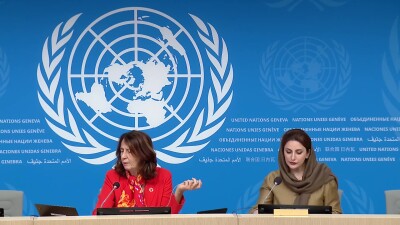
UNHCR – ExCom Meeting, UNICEF – Nepal Recovery, IFRC – Flash Floods, WHO – Mental Health, IOM – South Sudan Floods, OCHA – DRC Humanitarian aid, UNHCR – Sahel Displacement, UNICEF – Yemen Update, IOM – Gaza Shelter, UN Women – Gaza Women, OHCHR – Arrests and detentions of Syrians by Israeli force
2
1
2
Press Conferences | UNCTAD
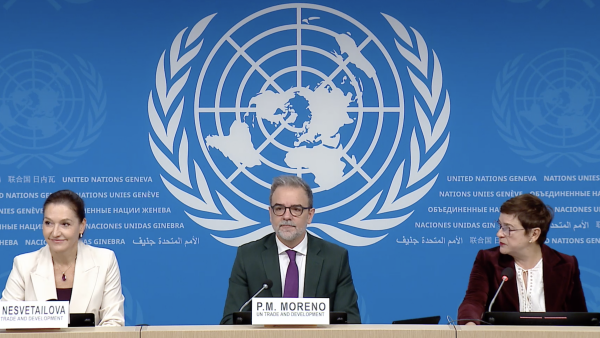
Presentation of the Trade and Developement Report 2026
Embargoed until 9 October 2026 at 11 a.m. (Geneva Time)
UNCTAD: UNCTAD’s flagship report finds that governments increasingly use industrial, trade, financial and technology policies to pursue economic and national security objectives. Market access and the ability to move into higher-value activities now depend more heavily on technology, finance and geopolitics.
1
1
1
Press Conferences | UPU
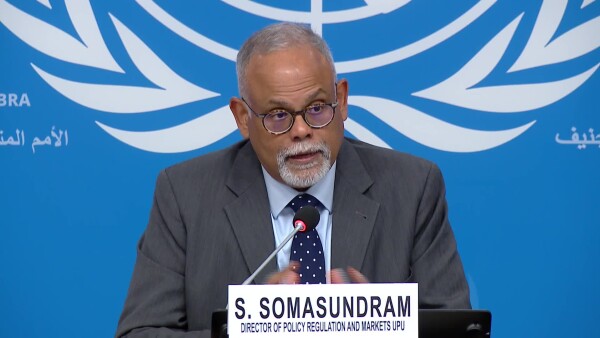
Release of the State of the Postal Sector Report 2026
1
1
1
Press Conferences | IOM , ITU , UNECE , UNICEF , WHO , WMO
UNICEF: Ebola, DRC - children orphans or separating them from parents and caregivers; IOM: Humanitarian needs in Djibouti amid arrivals from Yemen and increased migrant movements; WHO: Darfur, scale of health needs far exceeds available resources; WMO co-sponsored Global Heat Forum, Bangkok, monthly Global Seasonal Climate Update; UNECE: UN Forum of Mayors; ITU Plenipotentiary Conference 2026; WHO: child and adolescent obesity guidelines and new global roadmap to tackle pregnancy hypertension, a leading cause of maternal mortality
1
1
1
Press Conferences | OCHA , UN WOMEN , UNHCR , WFP , WHO , WTO , UNEP
OCHA – $160M CERF allocation to 12 underfunded crises; UNHCR – 5.8M refugee children remain out of school amid funding cuts; UN Women – Middle East escalation and food security among women/girls; WHO – Gaza supplies and overall situation; WFP – Yemen food insecurity and impact on global hunger ; UNEP - First International Conference of the Global Framework on Chemicals in Geneva | 16-20 November 2026
1
1
1
Press Conferences | UNHCR , WHO
Yemen's health system nears collapse amid conflict, causing rising casualties and medicine shortages.
1
1
1
Press Conferences | HRC
Update by the Expert Mechanism to Advance Racial Justice and Equality in Law Enforcement
1
1
1
Press Conferences | WIPO , WHO , UNICEF , UNHCR , IOM , WFP , FAO
WIPO Global Innovation Index 2026 launch and press conference, WHO Composition of influenza vaccines for the 2027 Southern Hemisphere flu season, UNICEF Yemen hunger and malnutrition; UNHCR Sudan displacement into Chad; IOM Ebola and population movements in DRC; WFP emergency food assistance in Nepal; and FAO food loss and waste.
2
1
2
Press Conferences | UNCTAD
Gaza reconstruction needs reach $71.5 billion as Palestinian economy and public finances face severe strain. Latest UNCTAD report documents the loss of decades of development gains, economic collapse in Gaza and tightening economic constraints in the West Bank.
The report identifies three immediate priorities: transferring withheld Palestinian revenues, safeguarding the banking system and aligning reconstruction support with the documented scale of damage and economic losses.
1
1
1
Press Conferences | HRC
Press conference on the situation of human rights in Nicaragua by the UN Group of Human Rights Experts