

The United Nations Office at Geneva
Multimedia Newsroom
Rhéal LeBlanc, Chief of the Press and External Relations Section of the United Nations Information Service, chaired the virtual briefing, attended by the spokespersons of the United Nations Refugee Agency, the International Labour Organization, and the World Health Organization.
World Breastfeeding Week
Laurence M. Grummer-Strawn, Head of Food and Nutrition Action in Health Systems Unit at the World Health Organization (WHO), said the theme for this year’s World Breastfeeding Week was “Support breastfeeding for a healthier planet”.
The Director-General of the WHO and the Executive Director of the United Nations Children’s Fund (UNICEF) had released a join letter calling on governments to protect and promote women’s access to skilled breastfeeding counselling, a critical component of breastfeeding support.
This issue was timely in the context of the COVID-19 pandemic, which had led to tremendous interruption of healthcare services around the world, including to breastfeeding mothers. The letter also called for increased investments, as analysis indicated that the lack of breastfeeding led to the death of 820,000 children every year, including in developed countries, and generated over US $302 billion in economic losses every year.
During World Breastfeeding Week, the WHO would be launching three new sets of documents and tools to help with capacity-building of health care providers in being able to support breastfeeding: a Competency Verification Toolkit: Ensuring Competency of Direct Care Providers to Implement the Baby-friendly Hospital Initiative; a manual on Care of Feeding for Small, Sick, and Preterm Newborns; and a Baby-friendly Hospital Initiative Training Curriculum. These materials would be launched during a webinar advocacy event, to be held at 3 p.m. CET on 5 August. There was also a frequently asked questions page on the code for health workers.
Responding to questions, M. Grummer-Strawn said there were no changes to WHO’s standard recommendations on breastfeeding even if mothers had COVID-19. The risk of transmission from a COVID-19 positive mother to her baby seemed extremely low. Breastmilk had been tested around the world, and infective virus had not been found in it, except for a few odd cases. He recalled that breastfeeding had positive effects for both the child and the mother. Turning to formula milk, he expressed concerns about the practices of formula industries trying to get mothers to use their products and weaken healthcare providers’ support for breastfeeding. Problematic marketing practices, such as issuing videos featuring doctors speaking negatively of breastfeeding while referring to COVID-19, had negative consequences beyond dissuading mothers from breastfeeding. They could lead, for instance, parliamentarians and employers to perceive breastfeeding as a less important issue.
COVID-19
Rhéal LeBlanc, for the United Nations Information Service (UNIS), said that, according to the Secretary-General’slatest policy brief on the impact of COVID-19 on education, the pandemic had created the largest disruption of education systems in history, affecting nearly 1.6 billion learners in all countries and all continents. It had also exacerbated education disparities. Learning losses due to prolonged school closures threatened to erase progress made in recent decades, not least for girls and young women. The Secretary-General had issued a video message on the launch of this policy brief.
Responding to questions on the licensing of a vaccine in Russia, Christian Lindmeier, for the World Health Organization(WHO), said there were clear guidelines and regulations to get this moving in an effective way. He noted that there had not been any official announcements yet on this matter. It was important that guidelines and regulations be followed.
Replying to questions about WHO’s mission to China, he explained that a two-person advance team had gone to China to meet Chinese experts, lay the groundwork to join efforts to identify the origin of the virus, prepare for future missions, and start drafting terms of reference. The Director-General had addressed this topic during a press briefing yesterday. The timeline, composition of the team and other information would be shared later.
He added that the WHO held two briefings per week on COVID-19, one on Mondays and the other on Thursdays.
First Universal Ratification of an International Labour Organization Convention
Roselind Yard, for the International Labour Organization (ILO), said the Organization was to announce the first universal ratification of an International Labour Standard in its more than 100-year history. Convention 182 on the Worst Forms of Child Labour had now been ratified by all 187 Member States, becoming the most rapidly ratified Convention in the history of the Organization. The Convention called for the prohibition and elimination of the worst forms of child labour, including slavery, forced labour and trafficking. Universal ratification meant all children now have legal protection against the worst forms of child labour.
An embargoed virtual press briefing would take place this afternoon at 2 p.m. Geneva time. ILO Director-General Guy Ryder would announce the universal ratification at the press briefing. Also speaking would be Corinne Vargha, Director of the ILO’s International Labour Standards Department, and Vera Paquete-Perdigao, Director of the ILO’s Governance Department. The press release and all associated materials would be under strict embargo until Tuesday 4 August at 1 p.m. GMT (3 p.m. CET). Audio and video of the briefing would be available after the press conference.
Attack on Internally Displaced Camp in Cameroon
Babar Baloch, for the United Nations Refugee Agency (UNHCR), said the UNHCR strongly condemned an unprovoked and brutal attack on a site hosting 800 internally displaced people near the village of Nguetchewe, in Cameroon’s Far North region. At least 18 people had been killed and 11 injured in the incident during the early hours of Sunday 2 August when assailants had thrown an explosive device, thought to be a grenade, into the makeshift camp while people were sleeping. Some of the wounded had been evacuated to Mokolo district hospital, an hour’s drive from Nguetchewe. Some 1,500 people, including terrified residents of the hosting village, had fled to the nearby town of Mozogo for safety. UNHCR was deploying an emergency mission to assess the situation and evaluate the protection and health needs of those affected. Local communities in this impoverished area were often the first responders to those fleeing growing insecurity and violence in the area, which covered Lake Chad and north-east Nigeria. They were sometimes related, and they shared with them the few resources they have. Against the background of growing insecurity, UNHCR anticipated enhanced community protection, shelter, water and sanitation would be needed as the country responded to the COVID-19 pandemic.
A briefing note is available here.
Rhéal LeBlanc, for the United Nations Information Service, said the Secretary-General had strongly condemned the heinous attacks against civilians, and called for those responsible for these atrocities to be held accountable. International human rights law and international humanitarian law must be fully respected and all civilians in Cameroon and Chad must be protected. The United Nations remained steadfast in its support to the countries of the Lake Chad Basin in their efforts to overcome the scourge of terrorism, and address the security, political, humanitarian and socio-economic challenges in the region.
Responding to questions, Mr. Baloch said access was an important issue for humanitarians in this region. He noted that the Far North region, tucked between Nigeria’s Borno and Adamawa states and Lake Chad, currently hosted over 300,000 internally displaced persons.
Geneva announcements
Rhéal LeBlanc, for the United Nations Information Service, reminded that the United Nations Conference on Trade and Development would be holding a virtual press briefing on the fact that Barbados was set to sign an agreement to host UNCTAD15 on Wednesday, 5 August at 1:30 p.m. GMT (9:30 a.m. in Barbados; 3:30 p.m. in Geneva). The speakers would include Mia Amor Mottley, Prime Minister of Barbados, and Dr. Mukhisa Kituyi, UNCTAD Secretary-General. Journalists must register prior to the event at unctadpress@unctad.org. The link to the event would be shared upon registration.
The 101st session of the Committee on the Elimination of Racial Discrimination (CERD) would open today at 3 p.m. This online session would last until Friday, 7 August. Due to the COVID-19 pandemic, the examination of State parties' reports that had been scheduled at the present session (Bahrain, Belgium, Bolivia, Denmark, France, Niger, Singapore and Thailand) had been postponed to future sessions. At the opening meeting this afternoon, the Committee would elect its new Bureau, including its new Chairperson. It would also hear a statement from a non-governmental organization. The Committee would then meet in private until Friday afternoon.
Similar Stories
1
1
1
Press Conferences | UN WOMEN , WFP , WHO
UN WOMEN: Sudan Women and girls one year after the fall of El Fasher; increasing drone attacks across the country; WFP: DRC - Ebola spreads to eighth DRC province as WFP delivers food, builds treatment centres and keeps supplies moving; WHO - Update on Ebola (Bundibugyo Virus Disease)
1
12
1
1
Press Conferences , Images | UNOG
Closing Press Conference following the Sixth Consultative Meeting on Enhancing Coordination of Peace Initiatives and Efforts in Sudan

2
17
1
2
Edited News , Press Conferences , Images | OCHA , WMO
Two UN agencies teamed up on Wednesday to issue an appeal for immediate assistance to help communities already being impacted by the strongest El Niño on record.
1
1
1
Press Conferences | CITES
Wildlife trade and conservation policy discussions at the 81st meeting of the CITES Standing Committee (SC81)
1
1
1
Press Conferences | UNHCR , UNCTAD , WMO , OCHA , UNICEF , WHO
UNHCR Hungary’s 1956 Refugee Crisis: 70 Years On, UNCTAD World Investment Forum 2026, Doha, WMO Greenhouse Gas Bulletin and Climate Update for COP31, OCHA Afghanistan: Malnutrition, Girls’ Education and Recovery, UNICEF Yemen: Child Malnutrition and Unsafe Water in Taiz, WHO Inequalities in Noncommunicable Diseases and Risk Factors
1
1
1
Press Conferences | UNHCR
End of UNHCR's 77th Annual Executive Committee (ExCom) meeting week
1
1
1
Press Conferences | UNICEF , IOM , UNHCR
UN Special Assistant to the Personal Envoy Office (SUDAN): Peace Initiatives and Efforts in Sudan; UNICEF: Dire situation of children in Gaza; IOM: Damaged Homes and Energy Attacks Risk Displacing Ukrainians for this winter; UNHCR: update on EXCOM week
1
1
1
Press Conferences | IOM , UNDRR
UN stresses importance of household preparedness for disaster risk reduction.
1
1
1
Statements , Press Conferences | OHCHR
1
1
1
Press Conferences | UNHCR , UNICEF , IFRC , OHCHR , UN WOMEN , IOM , OCHA , WHO
UNHCR – ExCom Meeting, UNICEF – Nepal Recovery, IFRC – Flash Floods, WHO – Mental Health, IOM – South Sudan Floods, OCHA – DRC Humanitarian aid, UNHCR – Sahel Displacement, UNICEF – Yemen Update, IOM – Gaza Shelter, UN Women – Gaza Women, OHCHR – Arrests and detentions of Syrians by Israeli force
2
1
2
Press Conferences | UNCTAD
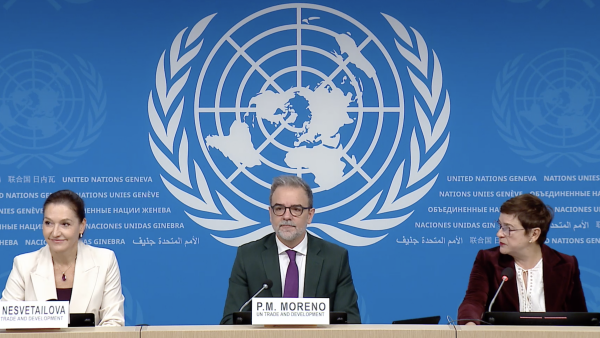
Presentation of the Trade and Developement Report 2026
Embargoed until 9 October 2026 at 11 a.m. (Geneva Time)
UNCTAD: UNCTAD’s flagship report finds that governments increasingly use industrial, trade, financial and technology policies to pursue economic and national security objectives. Market access and the ability to move into higher-value activities now depend more heavily on technology, finance and geopolitics.
1
1
1
Press Conferences | UPU
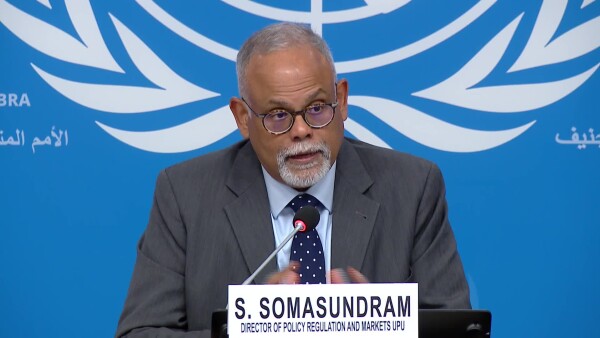
Release of the State of the Postal Sector Report 2026