

The United Nations Office at Geneva
Multimedia Newsroom
UN GENEVA PRESS BRIEFING
2 May 2025
Grave situation in Gaza
Jens Laerke, for the Office for the Coordination of Humanitarian Affairs (OCHA), reminded that it had now been two months since the Israeli decision to stop entry of any humanitarian aid to Gaza.
Olga Cherevko, for the Office for the Coordination of Humanitarian Affairs (OCHA), speaking from Gaza City, stated that there was probably little that had not already been said about the grim reality that was Gaza today. The decision makers had been watching in silence the endless scenes of bloodied children, of severed limbs, of grieving parents move quickly across their screens – month, after month, after month. Ms. Cherevko had spent close to five years in total working in Gaza, including ten months during the current war. Back in 2014, after another bloody escalation that lasted 51 days – the longest one at that point – a doctor in Rafah had told her that people had stopped daring to dream. Ten years later, people were telling her that they had stopped daring to live.
After nearly 18 months of bloodshed, Gaza was in ruins. Rubble filled the streets, and the sound of children playing was punctuated by the roar of explosions. Many nights, blood-curdling screams of the injured pierced the sky following the deafening sound of another explosion. Seconds later, the wailing sirens of the ambulances could be heard, as they rushed to save the injured and collect the dead. Exactly two months earlier, all entry points had been sealed by the Israeli authorities for the entry of cargo triggering the countdown to the worst-case scenario – supplies becoming depleted while the war raged on. Food stocks had mostly run out, water access was becoming impossible, and hospitals report running out of blood units, as mass casualties continued to arrive. Gaza was inching closer to running on empty as fuel was being rationed to maintain only the most critical operations. Ms. Cherevko spoke of people burning from explosions as there was no water to extinguish the fires.
Community kitchens had begun to shut down, with those still running only able to offer very modest meals, as more people were going hungry. Children across Gaza, deprived of their childhood for many months, were rummaging through the massive mountains of trash in search of material to burn for cooking. In an effort to survive, stations had been set up across Gaza that burned plastic and other toxic waste to produce fuel, as clouds of black smoke rose to Gaza’s skies, emanating dangerous fumes, endangering people’s lives and devastating the environment. In less than 1.5 months, over 420,000 people had been once again forced to flee, many with only the clothes on their backs, shot at along the way, arriving in overcrowded shelters, as tents and other facilities where people sought safety, were being bombed.
The international community had a choice – to keep scrolling through the grisly images of Gaza being suffocated and starved or muster the courage and the moral fiber to make decisions that would break this merciless blockade. The people in Gaza had no such choice: their fate hung in the balance of our collective responsibility to act. How much more blood had to be spilled before enough became enough?
Responding to numerous questions from the media, Ms. Cherevko explained that the last remaining food stocks had been given out. Portions of meals given in community kitchens, already insufficient, had to be further reduced. Ms. Cherevko had witnessed elderly people and children rummaging through piles of trash to find something to eat. People were literally fighting over scarce resources such as water. She reminded that no international journalists were allowed to be present in Gaza, but sufficient information was coming out of Gaza, thanks for the important work of local journalists and international organizations, who were doing their best to ensure that the focus remained on Gaza. Those who had the power to make decisions had to act now. Ms. Cherevko had witnessed malnourished children, and there were instances of people having been killed in violence over very scarce resources.
On other questions, Ms. Cherevko stressed that no place was safe in Gaza in this war. It was also the most dangerous place on Earth to be a humanitarian. There was a severe breakdown of law and order, which was a very real danger to people working to save lives. Crossings had to reopen, and OCHA stood ready to continue bringing in supplies as soon as that was done. The decision on reducing UN footprint in Gaza had been a very difficult one, but that did not mean that humanitarian operations had stopped, said Ms. Cherevko. She reminded that local staff had never stopped working. The Gaza of today was completely unrecognizable; life had not been easy even before the current war, but people were now longing to return to those days. It was not easy to live and work in such context, but humanitarian workers made the choice to be there and help save as many lives as possible. The most effective way to deliver assistance was through land, explained Ms. Cherevko.
Impact of the funding crunch on refugees
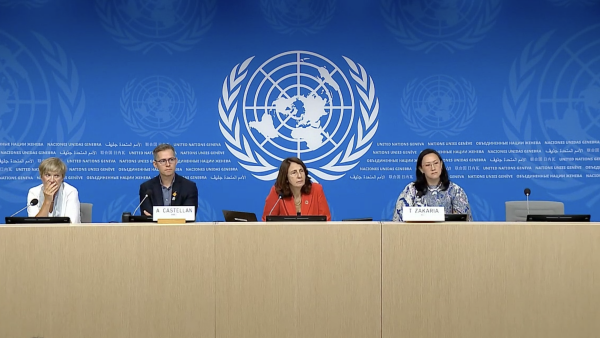
Elizabeth Tan, Director of International Protection at the United Nations Refugee Agency (UNHCR), spoke of the impact of the humanitarian aid cuts on refugees, who were among the most vulnerable populations worldwide. Because of funding shortages, the long-existing values of helping and welcoming people in need were now at risk. Refugees, unlike migrants, could not safely return home, which was why UNHCR had been created in 1950. UNHCR was working to help both refugees and States provide protection to people forced to flee. Two-thirds of refugees lived in countries bordering their own, and most of those countries had scarce resources; the strains on local communities were therefore immense. Without solidarity in those countries and the burden-sharing mechanism, which primarily came through humanitarian aid, that safety net in neighbouring countries was now at risk. UNHCR’s role was to support countries to allow refugees into their territorites, help determine who was a refugee, assist with registration and contribute to aiding them. UNHCR worked with governments on all those aspects.
Ms. Tan stressed the importance of registration, which helped identify who was a refugee and who was most vulnerable and needed assistance the most. It also allowed refugees to identify themselves to local authorities, including the police, so that they would not be detained and sent back to their countries. Some refugees, including those who had experienced sexual violence or torture, were more vulnerable and needy than others. UNHCR and partners provided specialized services to those categories; this was not a luxury – it was lifesaving. Youth were particularly vulnerable to being recruited to armed groups and of labour exploitation. There were good reasons to make sure there is stability in the first country to which refugees arrived.
UNHCR’s job was to look for long-term solutions for refugees, as nobody wanted to remain a refugee for life. People were choosing to return even to places still affected by conflict and instability, such as Syria or the Central African Republic. For example, there were 12,000 people in Chad who wanted to return home to the Central African Republic and needed support to do so. The institution of asylum was also under threat, and governments were raising alarm bells. Uganda, for example, was hosting well over a million refugees, and with a continued influx of displaced people, the country was struggling to deal with it. Host countries also needed to ensure that the standard of living of their domicile populations was not deteriorating, said Ms. Tan. She emphasized that if refugees did not find safety in the neighbouring countries, they would either need to return home to unsafe situations or move forward, often on dangerous journeys. She concluded by stressing the importance of sharing burden and responsibility, as well as international solidarity, which was under threat and ought to be re-established.
More details can be found in UNHCR’s briefing note.
Answering questions, Ms. Tan said that refugees worldwide were seriously affected by funding cuts. The United States had traditionally been the most generous country, receiving refugees from around the world, and the change of US policy had a very adverse effect on those who had been awaiting resettlement. By having access to labour markets in third countries refugees could contribute to their economies, explained Ms. Tan. Matthew Saltmarsh, also for UNHCR, responding to a question, emphasized the very unique mandate of UNHCR. In the current severely restricted funding requirement, UNHCR and other UN agencies were exploring possibilities of increasing efficiencies within the sector.
2025 Human Development Report
Alessandra Vellucci, for the United Nations Information Service (UNIS), speaking on behalf of the United Nations Development Programme (UNDP), said that UNDP would release the 2025 Human Development Report on 6 May. This new edition of UNDP’s flagship publication, titled "A Matter of Choice: People and Possibilities in the Age of AI," would reveal a troubling new reality: human development is losing momentum and is precariously fragile, while inequalities between rich and poor countries continued to widen. Without action, the world could find itself on the brink of a development crisis.
The report addressed one of the seminal issues of our time: Artificial Intelligence (AI) and its implications for human development. It advocated for a human-centered approach to AI, which had the potential to fundamentally redesign approaches to development. A global survey, included as part of the launch, revealed that people worldwide are ready for this kind of 'reset.' Ms. Vellucci reminded that the Human Development Report, now in its 35th year, was one of the major UN publications, with its report and data typically reaching over three million people from over 220 countries and territories every year.
More information is available here.
Announcements
Alessandra Vellucci, for the United Nations Information Service (UNIS), informed that the Committee Against Torture was ending its 82nd session this morning. It would release its concluding observations regarding the reports submitted during the session by Armenia, France, Mauritius, Monaco, Turkmenistan, and Ukraine.
The Committee on the Elimination of Racial Discrimination was concluding this morning its review of the report of Kirghizstan.
The second part of the 2025 session of the Conference on Disarmament would start on 12 May, still under the presidency of Kazakhstan.
Finally, on the occasion of the World Press Freedom Day, 3 May, Ms. Vellucci shared part of the Secretary-General’s message, in which he emphasized that free and independent journalism was an essential public good, and the backbone of accountability, justice, equality, and human rights.
***
Similar Stories
1
1
1
Statements , Press Conferences | OHCHR
1
1
1
Press Conferences | UNHCR , UNICEF , IFRC , OHCHR , UN WOMEN , IOM , OCHA , WHO
UNHCR – ExCom Meeting, UNICEF – Nepal Recovery, IFRC – Flash Floods, WHO – Mental Health, IOM – South Sudan Floods, OCHA – DRC Humanitarian aid, UNHCR – Sahel Displacement, UNICEF – Yemen Update, IOM – Gaza Shelter, UN Women – Gaza Women, OHCHR – Arrests and detentions of Syrians by Israeli force
2
1
2
Press Conferences | UNCTAD
Presentation of the Trade and Developement Report 2026
Embargoed until 9 October 2026 at 11 a.m. (Geneva Time)
UNCTAD: UNCTAD’s flagship report finds that governments increasingly use industrial, trade, financial and technology policies to pursue economic and national security objectives. Market access and the ability to move into higher-value activities now depend more heavily on technology, finance and geopolitics.
1
1
1
Press Conferences | UPU
Release of the State of the Postal Sector Report 2026
1
1
1
Press Conferences | IOM , ITU , UNECE , UNICEF , WHO , WMO
UNICEF: Ebola, DRC - children orphans or separating them from parents and caregivers; IOM: Humanitarian needs in Djibouti amid arrivals from Yemen and increased migrant movements; WHO: Darfur, scale of health needs far exceeds available resources; WMO co-sponsored Global Heat Forum, Bangkok, monthly Global Seasonal Climate Update; UNECE: UN Forum of Mayors; ITU Plenipotentiary Conference 2026; WHO: child and adolescent obesity guidelines and new global roadmap to tackle pregnancy hypertension, a leading cause of maternal mortality
1
1
1
Press Conferences | OCHA , UN WOMEN , UNHCR , WFP , WHO , WTO , UNEP
OCHA – $160M CERF allocation to 12 underfunded crises; UNHCR – 5.8M refugee children remain out of school amid funding cuts; UN Women – Middle East escalation and food security among women/girls; WHO – Gaza supplies and overall situation; WFP – Yemen food insecurity and impact on global hunger ; UNEP - First International Conference of the Global Framework on Chemicals in Geneva | 16-20 November 2026
1
1
1
Press Conferences | UNHCR , WHO
Yemen's health system nears collapse amid conflict, causing rising casualties and medicine shortages.
1
1
1
Press Conferences | HRC
Update by the Expert Mechanism to Advance Racial Justice and Equality in Law Enforcement
1
1
1
Press Conferences | WIPO , WHO , UNICEF , UNHCR , IOM , WFP , FAO
WIPO Global Innovation Index 2026 launch and press conference, WHO Composition of influenza vaccines for the 2027 Southern Hemisphere flu season, UNICEF Yemen hunger and malnutrition; UNHCR Sudan displacement into Chad; IOM Ebola and population movements in DRC; WFP emergency food assistance in Nepal; and FAO food loss and waste.
2
1
2
Press Conferences | UNCTAD
Gaza reconstruction needs reach $71.5 billion as Palestinian economy and public finances face severe strain. Latest UNCTAD report documents the loss of decades of development gains, economic collapse in Gaza and tightening economic constraints in the West Bank.
The report identifies three immediate priorities: transferring withheld Palestinian revenues, safeguarding the banking system and aligning reconstruction support with the documented scale of damage and economic losses.
1
1
1
Press Conferences | HRC
Press conference on the situation of human rights in Nicaragua by the UN Group of Human Rights Experts
1
1
1
Press Conferences | ITU , UNHCR , WHO , WMO
YEMEN - UNHCR: Escalating conflict in Yemen could fuel more displacement, refugee movement
CLIMATE - WHO / WMO: Health and Climate impact of El Niño