

The United Nations Office at Geneva
Multimedia Newsroom
Press Conferences | IOM , OHCHR , UNDP , UNHCR , UNICEF , UN WOMEN
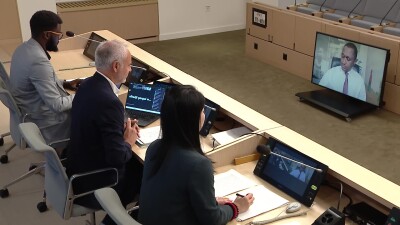
UN Geneva Press Briefing - 15 April 2025
UN GENEVA PRESS BRIEFING
15 April 2025
Two years of war in Sudan
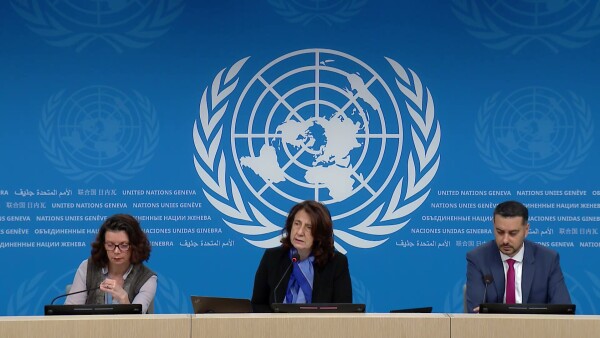
Alessandra Vellucci, for the United Nations Information Service (UNIS), quoted from the Secretary-General’s statement who said that civilians continued to bear the brunt of the parties’ disregard for human life. In addition to their obligations under international humanitarian and international human rights law, the warring parties had made commitments to protect civilians, including in the Jeddah Declaration of May 2023. Such commitments had to be translated into concrete action. Independent, impartial and transparent investigations into all reports of violations and abuses were also crucial. The Secretary-General was deeply concerned that weapons and fighters continued to flow into Sudan, allowing the conflict to persist and spread across the country. The external support and flow of weapons had to end. Full statement is available here.
Luca Renda, United Nations Development Programme (UNDP) Resident Representative in Sudan, speaking from Port Sudan, said he had just returned from a mission to the Khartoum area, the first visit since the beginning of the war. On its second anniversary, the situation remained grim - the worst humanitarian crisis in the world by all accounts. The war had taken an enormous toll on both people and the economy of the country. Some 26 million people were food insecure and 11 million had been displaced. There had been a 40 percent drop in GDP and triple digit inflation; fewer than 25 percent of health facilities were working and there had been outbreaks of cholera and malaria. Access to water, sanitation and electricity was severely limited.
About a third of internally displaced people had come from Khartoum when the war had started there. There was eagerness among these people to return to their homes now. Some three million could be returning to the capital in the coming months, said Mr. Renda, and another million to other regions. They needed help to get back on their feet, particularly to rebuild and restart national systems rather than using temporary parallel systems to provide basic services. This included making sure it was safe to return, by clearing mines and debris; providing water, electricity and healthcare; helping people find jobs and income generation opportunities through, for example, cash-for-work interventions; and providing access to loans to rebuild houses and restart businesses. The UN was going to work in a coordinated fashion to ensure that the returns were organized, dignified, and voluntary, in line with international standards.
Anna Mutavati, Regional Director of UN Women for East and Southern Africa, speaking from Port Sudan, started by expressing solidarity with the women of Sudan who were bearing the brunt of one of the world’s worst humanitarian emergencies, to listen to their concerns, and to reassure them that they were not alone. Just a few days before, 400 civilians had lost their lives in the attack in Darfur. UN Women condemned in the strongest terms this unwarranted attack on civilians which went against international humanitarian law. Thousands of civilians that were trapped in the Darfur region had no access to crucial lifesaving services including food and health. UN Women called for humanitarian access and protection of humanitarian aid workers providing lifesaving support civilians in the region.
The war’s toll was devastating: there had been a 288 percent increase in demand for lifesaving support following rape and sexual violence; and women’s bodies had become battlegrounds in this conflict, with sexual violence and rape being systematically used as a weapon of war. Lack of food, medical care, and drinking water had become the norm, while children had lost access to education and lived in constant fear. Sudanese women’s organizations were at the frontline of the response, said Ms. Mutavati. Many women had been pillars of Sudanese civil society for decades, promoting women’s rights, education, and leadership in political decision-making. They now asked for justice and that perpetrators of the violence against them be held accountable. These women should not be abandoned.
Salvator Nkurunziza, Country Representative of UN Women in Sudan, also connecting from Port Sudan, stressed that all the work that UN Women did in Sudan was with, for, and through women’s organizations, who were at the forefront of our response to gender-based violence, access to humanitarian services, and building livelihoods for women’s economic empowerment. UN Women would remain in Sudan, delivering, standing with these organizations, giving them a voice in humanitarian assistance, demanding lasting peace, and championing a leading role for women and girls in shaping the future of this country. Mr. Nkurunziza said that empowering local women’s organizations was essential to everything UN Women does in Sudan.
These organizations helped identify urgent needs in displacement camps, support survivors of gender-based violence, and provided psychosocial care and livelihoods training. They worked within their own communities to support those who needed it most, including women with disabilities, pregnant women, and women-led households. These women-led organizations urgently needed long-term support, well beyond short-term emergency funding, but they received under two percent of humanitarian assistance in Sudan. Supporting women in Sudan had to be at the heart of the humanitarian response. When women led, when women were heard, humanitarian needs were met, concluded Mr. Nkurunziza.
Mohammedali Abunajela, for the International Organization for Migration (IOM), said that most of the world knew little or nothing about the devastating war in Sudan, which had forced more than 12 million from their homes, two-thirds of whom inside the country. It was the largest humanitarian crisis and there were no words left to describe how dire the situation was. Shocking, systematic abuse against civilians was ongoing, with women and children most at risk. Deplorable attacks against hospitals and aid workers continued to violate international humanitarian law. Few people in the world even knew this terrible conflict was happening. This had to change, and Sudan deserved to be put in international spotlight. Urgent action was needed, not only for the sake of humanity, but also to avert broader insecurity in the region, stressed Mr. Abunajela.
Despite ongoing hostilities, many people were trying to return homes, often only to find their houses destroyed. IOM had been providing support to millions of people around the country since the start of the conflict. IOM was also providing critical data on displacement which was helping formulate international response. However, IOM’s appeal was only ten percent funded, so much more support was needed from donors. People of Sudan needed peace more than anything else.
Mohamed Refaat, Chief of Mission for the International Organization for Migration (IOM) in Sudan, connecting from Port Sudan, spoke of having met women who had experienced sexual violence by actors in the war, and had openly spoken about it. The violations of international humanitarian law, which were rampant, were used to force displacement onto people. It was the world’s largest displacement crisis, and the scale of humanitarian needs was vast. While people were returning to Khartoum, and there was some renewed hope, the war was far from over. What was being seen in Al Fasher now was displacing numerous people, and many Darfurians were being moved to Egypt by smugglers. IOM would be asking for USD 29 million in its Khartoum Response Plan, to be launched today.
Full press release from the IOM is available here, while latest data on returns in Sudan can be accessed here.
Answering questions from the journalists, Mr. Refaat, for the IOM, said that as many as 80,000 people had already been displaced from the Zamzam camp in Darfur; the displacement in different directions was continuing and the total number could reach 400,000. Ms. Vellucci, for UNIS, said that the London conference on Sudan was expected by the UN to galvanize international support for Sudan. Any effort being undertaken by Member States, regional groups or associations, was welcome and received with hope that it would bring a more coordinated approach to help Sudan, added Mr. Renda, for UNDP. People in Sudan were exhausted from the war, and any activity that could bring it closer to an end was welcome. He said that mine and UXO clearance in Khartoum would take time; the Governor of Khartoum had asked people to delay their returns to allow some clearance. A massive flow of people returning home was expected in the states of Khartoum and Gezira in the coming months.
Ms. Mutavati, for UN Women, stressed that women in Sudan were more than just victims; they had played an important role in shaping the history of their country. This was a time to bring women to the table and to ensure that they contributed to ending the war and shaping sustainable peace. She also spoke of the stigma associated with rape and sexual violence experienced by women. Behind every figure were real people and shuttered lives, and real women carrying the shame. The perpetrators, not the women, were the ones who ought to carry that shame and be held accountable. Some 2.1 million people were expected to return to the capital city of Khartoum in the coming months, estimated Mr. Refaat, for IOM. Regarding movement from Darfur to other countries, he said that Darfurians were now on the move toward Libya, Egypt, and Chad. What was happening in Darfur hence had an inevitable regional impact. Mr. Renda, for UNDP, elaborated on the need to invest vital resources in recovery, going beyond immediate humanitarian aid.
Israeli operations in Lebanon continue to kill civilians
Thameen Al-Kheetan, for the Office of the High Commissioner for Human Rights (OHCHR), stated that Israeli military operations in Lebanon continued to kill and injure civilians, and destroy civilian infrastructure, raising concerns regarding the protection of civilians. According to OHCHR’s initial reviews, at least 71 civilians had been killed by Israeli forces in Lebanon, since the ceasefire of 27 November 2024. Among the victims had been 14 women and nine children. People remained gripped by fear, and over 92,000 were still displaced from their homes. Most recently, for the first time since the ceasefire, the southern suburbs of Beirut had also been hit in two different incidents. The area targeted had been in the vicinity of two schools. Tens of thousands of Israelis were also reportedly displaced from northern Israel.
The violence had to stop immediately. All parties to the conflict had to respect international humanitarian law, including the principles of distinction, proportionality and precaution. There had to be prompt, independent and impartial investigations into all allegations of serious violations of international humanitarian law, and those found responsible needed to held to account. All those internally displaced, in Lebanon and in Israel, should be able to safely return home. Unexploded remnants of war in southern Lebanon should be removed to ensure people can safely resume their lives upon return. UN High Commissioner for Human Rights Volker Türk urged all parties to respect the commitments made under the ceasefire.
Full statement is available here.
Answering questions, Mr. Al-Kheetan explained that the OHCHR was not monitoring the implementation of UN Security Council resolution 1704 (2006), but was focused on the protection and promotion of human rights. Launching of rockets from Lebanon into Israel also had to stop, so that displaced Israelis had to return home and live in peace. The ceasefire had to hold on both sides of the border, stressed Mr. Al-Kheetan.
Thousands of children’s deaths in the Mediterranean
Nicola Dell’Arciprete, Country Coordinator of the United Nations Children’s Fund (UNICEF) in Italy, speaking from Rome, said that ten years earlier, around 1,050 people had climbed aboard a flimsy wooden boat in Tripoli, Libya, many of them fleeing war and conflict. They had been hoping to reach safety in Europe. Instead, their overcrowded boat had gone down, killing 1,022 people. Despite promises of “never again” following the 2015 disaster, an estimated 3,500 children had since died or disappeared attempting the same journey to Italy, a rate of roughly one child every day. In total, more than 20,800 lives had been lost on this perilous route, informed Mr. Dell’Arciprete. These figures were likely underestimates.
Children accounted for nearly 17 per cent of those who made it across the Central Mediterranean to Italy; of those, around 70 per cent were travelling alone, without a parent or legal guardian. UNICEF was working on the ground in Italy with the Government and other partners to meet children’s immediate needs and support their long-term integration into the communities where they now live. UNICEF also worked in their countries of origin to ease the impact of the problems that fueled global refugee and migrant movements, from poverty to climate change and conflict. UNICEF called on them to use the Migration and Asylum Pact to prioritize the best interests of children. Mr. Dell’Arciprete also spoke about the need to invest more in services for children, because every child in every reception centre was entitled to the same rights and services as a child born in the European Union. A decade on from a tragedy that had been meant to change everything, the reality was clear: the promises of “never again” had not been kept. We needed action now, concluded Mr. Dell’Arciprete.
Responding to questions, he said that in the summer season there were usually more crossing attempts. The numbers in 2024 and early 2025 were decreasing compared to earlier years, but there was a considerable percentage of people needing immediate support. Thorough age assessments were necessary to ensure there would be no unlawful sending of children to detention centres in Albania.
Floods and conflict fuel an alarming humanitarian emergency in DR Congo
Eujin Byun, for the United Nations Refugee Agency (UNHCR), said that severe flooding triggered by torrential rains in recent weeks had displaced almost 10,000 people in Tanganyika Province. This unfolding emergency reflected the double crisis facing the DRC, where extreme weather shocks such as flooding compound the suffering caused by ongoing conflict and mass displacement. The flooding had hit a community already under severe strain. Since January, Tanganyika had received around 50,000 internally displaced people fleeing violence in South Kivu. Many had been sheltering in local homes, churches, and schools—now damaged or destroyed. The floods had also wiped out key crops like cassava, maize, and peanuts, worsening an already serious food insecurity situation in the country. According to recent assessments, 2.3 million people across four provinces affected by ongoing conflict — South Kivu, North Kivu, Ituri, and Tanganyika — faced life-threatening hunger in the coming months unless urgent action was taken.
Ms. Byun informed that UNHCR had received only 20 per cent of the funding needed to carry out its life-saving response in the DRC. The people of the DRC were in dire need of aid, and without timely and adequate intervention, the consequences of this tragic double crisis would only deepen.
UNHCR statement can be accessed here.
Announcements
Sarah Bel, for the United Nations Development Programme (UNDP), reminded about its press release on the damage following the Myanmar earthquake. Urgent removal of some 2.5 million tons of debris was needed. Some 10,000 homes and public services buildings had been damaged or destroyed. The data provided an overview of the needs and help plan for recovery and rebuilding.
Alessandra Vellucci, for the United Nations Information Service (UNIS), said that a response plan for Syrian refugees would be launched by UNHCR and UNDP at 1 pm today.
She reminded that the World Trade Organization (WTO) would hold on 16 April an embargoed press conference on the "Global Trade Outlook and Statistics". The publication analysed recent global trade developments up to the fourth quarter of 2024 and presented the organization’s forecasts for world trade in 2025 and 2026. The press conference would be held in Room D at WTO at 2 pm, and on Zoom, and the embargo would be lifted at 3 pm; the speakers would be Director-General Ngozi Okonjo-Iweala and Chief Economist Ralph Ossa. Journalists wishing to participate either virtually or in person should email mediateam@wto.org.
This week, the Committee Against Torture was reviewing the report of Armenia and France.
This afternoon, the Committee on the Protection of the Rights of All Migrants Workers and Members of their Families would present its General Comment No. 6 (2024) on “the convergent protection of the rights of migrant workers and members of their families through the Convention and the Global Compact for safe, orderly and regular migration”. The Committee would close its session on 17 April, at around 5:30 pm
On 22 April, the Committee on the Elimination of Racial Discrimination would open its 115th session, during which the reports of the following countries were to be reviewed: Gabon, Kyrgyzstan, Mauritius, Republic of Korea, and Ukraine.
As 18 April would be a UN holiday, no briefing would be held that day.
Similar Stories
1
1
1
Press Conferences | UNHCR
End of UNHCR's 77th Annual Executive Committee (ExCom) meeting week
1
1
1
Press Conferences | UNICEF , IOM , UNHCR
UN Special Assistant to the Personal Envoy Office (SUDAN): Peace Initiatives and Efforts in Sudan; UNICEF: Dire situation of children in Gaza; IOM: Damaged Homes and Energy Attacks Risk Displacing Ukrainians for this winter; UNHCR: update on EXCOM week
1
1
1
Press Conferences | IOM , UNDRR
UN stresses importance of household preparedness for disaster risk reduction.
1
1
1
Statements , Press Conferences | OHCHR
1
1
1
Press Conferences | UNHCR , UNICEF , IFRC , OHCHR , UN WOMEN , IOM , OCHA , WHO
UNHCR – ExCom Meeting, UNICEF – Nepal Recovery, IFRC – Flash Floods, WHO – Mental Health, IOM – South Sudan Floods, OCHA – DRC Humanitarian aid, UNHCR – Sahel Displacement, UNICEF – Yemen Update, IOM – Gaza Shelter, UN Women – Gaza Women, OHCHR – Arrests and detentions of Syrians by Israeli force
2
1
2
Press Conferences | UNCTAD
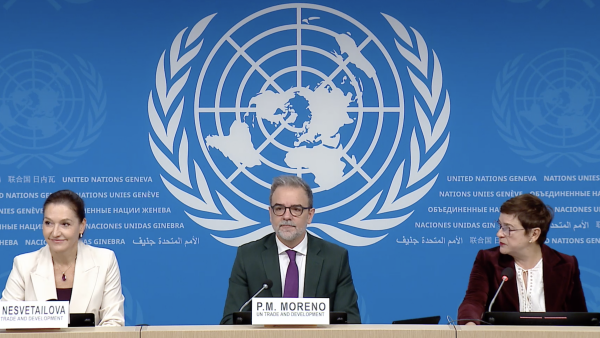
Presentation of the Trade and Developement Report 2026
Embargoed until 9 October 2026 at 11 a.m. (Geneva Time)
UNCTAD: UNCTAD’s flagship report finds that governments increasingly use industrial, trade, financial and technology policies to pursue economic and national security objectives. Market access and the ability to move into higher-value activities now depend more heavily on technology, finance and geopolitics.
1
1
1
Press Conferences | UPU
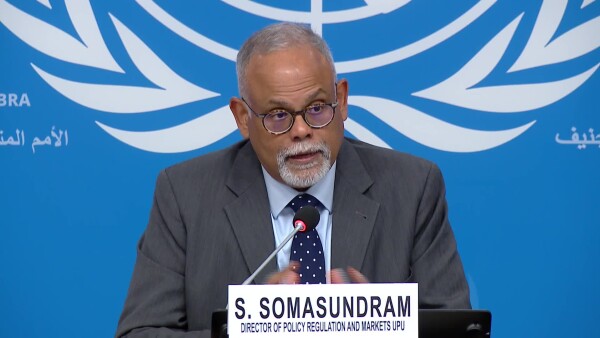
Release of the State of the Postal Sector Report 2026
1
1
1
Press Conferences | IOM , ITU , UNECE , UNICEF , WHO , WMO
UNICEF: Ebola, DRC - children orphans or separating them from parents and caregivers; IOM: Humanitarian needs in Djibouti amid arrivals from Yemen and increased migrant movements; WHO: Darfur, scale of health needs far exceeds available resources; WMO co-sponsored Global Heat Forum, Bangkok, monthly Global Seasonal Climate Update; UNECE: UN Forum of Mayors; ITU Plenipotentiary Conference 2026; WHO: child and adolescent obesity guidelines and new global roadmap to tackle pregnancy hypertension, a leading cause of maternal mortality
1
1
1
Press Conferences | OCHA , UN WOMEN , UNHCR , WFP , WHO , WTO , UNEP
OCHA – $160M CERF allocation to 12 underfunded crises; UNHCR – 5.8M refugee children remain out of school amid funding cuts; UN Women – Middle East escalation and food security among women/girls; WHO – Gaza supplies and overall situation; WFP – Yemen food insecurity and impact on global hunger ; UNEP - First International Conference of the Global Framework on Chemicals in Geneva | 16-20 November 2026
1
1
1
Press Conferences | UNHCR , WHO
Yemen's health system nears collapse amid conflict, causing rising casualties and medicine shortages.
1
1
1
Press Conferences | HRC
Update by the Expert Mechanism to Advance Racial Justice and Equality in Law Enforcement
1
1
1
Press Conferences | WIPO , WHO , UNICEF , UNHCR , IOM , WFP , FAO
WIPO Global Innovation Index 2026 launch and press conference, WHO Composition of influenza vaccines for the 2027 Southern Hemisphere flu season, UNICEF Yemen hunger and malnutrition; UNHCR Sudan displacement into Chad; IOM Ebola and population movements in DRC; WFP emergency food assistance in Nepal; and FAO food loss and waste.