

The United Nations Office at Geneva
Multimedia Newsroom
Press Conferences | UNDP , WMO , WHO , UNHCR , IFRC
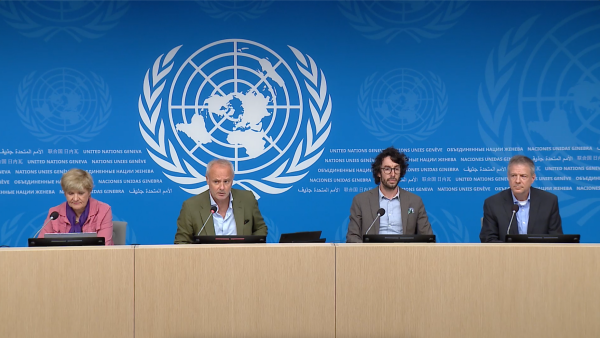
UN Geneva Press Briefing - 23 August 2024
PRESS BRIEFING BY THE UNITED NATIONS INFORMATION SERVICE
23 August 2024
Cholera outbreak in Sudan
Dr. Shible Sahbani, for the World Health Organization (WHO), speaking from Port Sudan, said a second wave of cholera had been declared on 12 August 2024. In one month since the first suspected cases were reported, there had been 658 cases and 28 deaths reported, with a high case-fatality ratio of 4.3 percent. WHO were working to address the causes including water sanitation, as well as vaccine distribution. A three-day oral cholera vaccination campaign in two localities of Kassala State concluded yesterday, with 51,000 doses of oral cholera vaccines deployed. In good news, the International Coordination Group fully approved the request for a total of 455,081 doses of the cholera vaccine, to implement a reactive vaccination campaign targeting the unvaccinated high-risk population in Kassala State. Sudan was also currently responding to outbreaks of measles, dengue fever, malaria and meningitis as well as polio. WHO were preparing a multi antigen immunization campaign for Darfur and called for support from the international community. There was a need to strengthen the early warning system to ensure there were no other outbreaks in the coming period. Eight months into the year, the Humanitarian Response Plan for 2024 was only 30 percent funded, which limited the capacity to launch a robust response to reach more people in need.
Kristine Hambrouck, for the United Nations High Commissioner for Refugees (UNHCR), also speaking from Port Sudan, said that the country was facing a new wave of cholera which had also affected refugee areas. There were 190 cases in three refugee sites in Kassala and five refugees had passed away due to the disease. Cholera was endemic to Sudan and the recent floods had caused an increase in water-borne diseases. Together with WHO and partners, UNHCR was scaling up cholera prevention and response efforts, through community outreach and cholera treatment centres, providing assistance to the Ministry of Health. The challenges were huge; it was a cholera crisis in a situation where the water, sanitation and hygiene systems were weak and humanitarians were facing extreme challenges, including the conflict. The work with WHO was ongoing and would require significant investments to ensure the early warning systems and water and sanitation services were in place. All areas had become hugely overcrowded and the water systems needed massive investment. This needed to be addressed jointly with all agencies, the government and all parties. UNHCR had an eye across the border and had seen large refugee movements towards Chad, South Sudan and Ethiopia. These countries were also facing challenges including floods and required investments to bring possible disease outbreaks under control. Funding levels were extremely challenging and did not allow UNHCR to address all needs. An international effort was required to stabilise the cholera situation.
Responding to questions, Dr. Sahbani said it was challenging to deploy technical teams and access certain areas. The different parties had mentioned they would facilitate the process. He welcomed the opening of the Adré Crossing point between Chad and Sudan and hoped this would be kept open. Even with this goodwill, there were obstacles, including miscommunication between decision makers and those in the field, a lack of funds and the quality of the roads. The overall appeal was funded up to one third. The health sector was now funded to around 47 percent. WHO had asked for 85.6 million dollars and had only received a third of what was needed. Without sufficient funds, WHO could not strengthen their early warning and response system and could not respond to other issues, including outbreaks of other non-communicable diseases. The needs were huge, and the funding had not reached expectations. Five states were impacted by cholera, including Kassala, Gedaref, Ak Jazirah, Khartoum and River Nile, with Kassala being the most affected. Kassala was hosting a large population of displaced persons and refugees. The additional movement of the population had put a burden on the health system and water, sanitation and hygiene systems, which could not cope with the additional influx of refugees. Mr. Sahbani commended the great work done by front liners and implored partners to work together to address and contain the outbreak.
Responding to question Ms. Hambrouck said so far there were no cases of cholera in neighbouring countries, but this was being monitored. The funding was a challenge but there had been generous donations coming in, for which they were very grateful. The needs were huge in Sudan; there was conflict and people were dying on a daily basis. It was important to gather evidence with surveillance mechanisms, to bring out as much data and reporting as possible and have conversations with those who could help. The best solution would be for the fighting to stop.
Responding to questions, Jens Laerke, for the United Nations Office for the Coordination of Humanitarian Affairs (OCHA), said the UN and humanitarian partners continued to engage with the Sudanese authorities to ensure the sustained and scaled-up delivery of supplies into Sudan. This was crucial to meet people’s most urgent needs at the height of the rainy and lean seasons in Darfur. The 15 trucks that crossed into Sudan from Chad via the Adré crossing this week were a step in the right direction. However, fighting the deepening hunger crisis in Sudan meant making sure aid trucks could continue to cross there to secure a steady flow of food, nutrition, water, sanitation, hygiene, and medical supplies for people in more than a dozen areas at risk of famine. Some of these supplies were seeds for farmers in Darfur, who needed to plant before the rainy season ended. Boosting food production in Sudan was one of the most effective ways to address the overwhelming hunger crisis, which was only worsening after more than 16 months of conflict.
Responding to further questions, Mr. Laerke said there were 15 trucks which had passed through the crossing, with 131 approved. There were several issues including the approvals and the rainy conditions. It was important for this momentum to continue.
Responding to further questions, Mr. Sahbani said the vaccination campaign had already begun and the 51,000 doses in the country had already been used. This aimed to reach 97 percent of the target popultion. The good news was that there had been an approval for more than 450,000 doses of the cholera vaccine. The most impacted states were directly reachable from Port Sudan, meaning it would be easier to continue the vaccination campaign. One dose provided protection for up to six months, with two doses providing protection for up to three years. This would help WHO contain the outbreak.
Mr. Sahbani said an International Coordination Group on vaccine coordination was a mechanism with pooled funds contributed by different donors. The committee approved the allocation of vaccines to different countries, according to requests. There were a range of donors, development and humanitarian. WHO were still calling for other donors to continue to support WHO and the health sector in general.
Mpox response and the launch of the IFRC emergency appeal
Gwendolen Eamer, for the International Federation of the Red Cross (IFRC), began with the story of Hélène Mula, a Red Cross volunteer from Mbandaka in the Democratic Republic of the Congo who was a frontline responder, supporting many families in her area in regard to mpox. The IFRC had been preparing for moments like this for many years, but the scale of the outbreak meant more resources were urgently needed. For this reason, IFRC had launched an emergency appeal for 40 million Swiss francs to help scale up their response. This would expand community-based surveillance, strengthen health promotion efforts, provide psychosocial and material support to affected families, and ensure Red Cross Red Crescent volunteers had the tools needed to continue their lifesaving work.
The money would be used in countries with active outbreaks, including the Democratic Republic of Congo and Burundi, as well as to prepare countries in Africa with imported cases. Red Cross and Red Crescent National Societies at risk would be supported to deliver targeted interventions to strengthen surveillance, support people with mpox, identify contacts, provide psychosocial and material support to mpox patients and their families and to reach high-risk populations. This response also aimed to build long-term resilience in communities across Africa, including through ensuring access to vaccines and supportive care, scaling up testing, and addressing the ongoing stigma that surrounded the disease. Mpox disproportionately affected the most marginalised and vulnerable. The IFRC and its members, with four million community volunteers across Africa, were uniquely positioned to help. The IFRC needed international solidarity and support. The 40 million Swiss francs would aim to assist 30 million people and ensure the most vulnerable were not left behind.
Tommaso Della Longa, for the International Federation of the Red Cross (IFRC), said a press release on the emergency appeal would be shared by lunchtime.
Responding to questions, Tarik Jasarevic, for the World Health Organization (WHO), said there was a reason to be concerned, which was why WHO had declared mpox to be a global health emergency. Mpox was being spread through close, skin-to-skin contact. WHO were concerned; countries should be ready if mpox came to their territory. Basic public health measures, including ensuring that an infected person did not infect anyone else, broke transmission chains.
#I’mSahel campaign
Ahunna Eziakonva, Assistant Secretary-General and United National Development Programme (UNDP) Regional Director for Africa, speaking from Japan, said UNDP had been working in the Sahel region for years, but had been making little headway despite enormous investment. Upon reflection, this was because the region was being viewed through a crisis lens, rather than the opportunity lens. The campaign looked to switch the lens under which the region was viewed to see people of colour, creativity, talent, innovation. The #IAMSahel campaign showed Sahel people as creatives, fashion designers, scientists and educators; people who could regenerate the region. It was important to tell their story and invest in their agency, rather than dimmish it through the way the region was portrayed. UNDP was working with several actors and partners in the region to tell a different story, to help them overcome the region’s numerous challenges. They were helping to drive a new narrative which would help the region exit from its own vulnerabilities.
Responding to questions, Ms. Eziakonva said she was in Japan to attend the ministerial meeting of the Tokyo International Conference on African Development. While there, young people would be a key topic, including Sahelian youth. There would be a big focus on youth, innovation and start-ups. Africa was young and investing in youth and talent would help drive down poverty. While Japan’s meeting was not on Sahel, some similar themes would be explored.
Release of WMO State of the Climate in South-West Pacific report 2023
Clare Nullis, for the World Meteorological Organization (WMO), said the WMO Secretary-General Celeste Saulo was today traveling to the Southwestern Pacific Islands forum where she would join United Nations Secretary-General António Guterres on the weekend. On Monday, the WMO would release the State of the Climate in the South-West Pacific 2023 Report at a press conference with António Guterres in Tonga, during the forum. There would be a heavy emphasis on sea level rise, ocean heat content and sea surfaces which were having an increasingly devastating impact on the Pacific Islands. A press release would be sent under embargo for 11am Tonga time on August 27. Pacific islands were extremely vulnerable and early warnings made a difference between life and death. Therefore, Professor Saulo would engage in a number of activities connected with the early warnings for all campaign, with local institutions in Tongo, to highlight the needs and efficacy of early warnings.
Michele Zaccheo of the United Nations Information Service (UNIS), said the Secretary-General was currently visiting Samoa and Tonga where he would participate in the Pacific Islands Forum Leaders Meeting. He would make site visits to engage with local communities, civil society organizations and young people, where he would emphasise the impacts of sea level rise in the region and beyond. During the WMO press conference in Tonga, the Secretary-General would highlight the present-day impacts and future projections of sea level rise, including coastal flooding at the global and regional level. A technical brief would be published on the UN Climate action site at the time of the press conference. Ahead of the Conference, a background briefing would be held at 3 pm today with Selwin Heart, Special Advisor to the Secretary-General on Climate Action. Registration was required.
Announcements
Michele Zaccheo of the United Nations Information Service (UNIS) said the Permanent Mission of Switzerland would hold a press stakeout at 12pm on Monday, August 26, following the visit of the UN Security Council Members to Geneva. Speakers included Ignazio Cassis, Head of the Federal Department of Foreign Affairs of Switzerland and Timothy Kabba, Minister of Foreign Affairs and International Cooperation of Sierra Leone.
On Tuesday, 27 August at 8:15 a.m., WIPO would host a virtual press conference on the launch of Science and Technology Clusters pre-release, excerpt from Global Innovation Index 2024. Speakers included Daren Tang, Director General and Carsten Fink, Chief Economist.
Also on Tuesday, 27 August, at 9:45 a.m. the United Nations Secretary-General's High-level Advisory Body would hold a hybrid press conference on Global AI Governance Recommendations. Speakers included: Carme Artigas, Co-Chair of the HLAB on AI and former Secretary of State for Digitalization and Artificial Intelligence, of Spain; Latifa Al-Abdulkarim, Member of the Shura Council of the Saudi Parliament; and Seydina Moussa Ndiaye, Lecturer at Cheikh Hamidou Kane Digital University in Senegal.
The Committee on the Elimination of Racial Discrimination would conclude its 113th session this afternoon, at 4pm, and issue its concluding observations. Also today, the Committee on the Rights of Persons with Disabilities was reviewing the report of Denmark.
The Committee on the Rights of the Child would open its 97th session next Monday morning at 10am, during which it would review the reports of Bahrain, Turkmenistan, Mexico, Argentina, Israel and Armenia.
The date of the next public plenary meeting of the Conference on Disarmament would be announced at a later stage.
Responding to questions, on the AI Governance report, Mr. Zaccheo said the work was being done in New York. He was unsure if it would be launched in Geneva, but there would be people in town next week which would be a good opportunity for media engagement.
***
TOPICS
- WHO - Dr Shible Sahbani, WHO Representative in Sudan (From Port Sudan): Update on cholera in Sudan
- UNHCR - Kristine Hambrouck, UNHCR representative in Sudan (From Port Sudan): New cholera outbreak threatening refugees and displaced communities amid ongoing war and flooding in Sudan
Similar Stories
1
12
1
1
Press Conferences , Images | UNOG
Closing Press Conference following the Sixth Consultative Meeting on Enhancing Coordination of Peace Initiatives and Efforts in Sudan

2
17
1
2
Edited News , Press Conferences | OCHA , WMO
Two UN agencies teamed up on Wednesday to issue an appeal for immediate assistance to help communities already being impacted by the strongest El Niño on record.
1
1
1
Press Conferences | CITES
Wildlife trade and conservation policy discussions at the 81st meeting of the CITES Standing Committee (SC81)
1
1
1
Press Conferences | UNHCR , UNCTAD , WMO , OCHA , UNICEF , WHO
UNHCR Hungary’s 1956 Refugee Crisis: 70 Years On, UNCTAD World Investment Forum 2026, Doha, WMO Greenhouse Gas Bulletin and Climate Update for COP31, OCHA Afghanistan: Malnutrition, Girls’ Education and Recovery, UNICEF Yemen: Child Malnutrition and Unsafe Water in Taiz, WHO Inequalities in Noncommunicable Diseases and Risk Factors

1
1
1
Press Conferences | UNHCR
End of UNHCR's 77th Annual Executive Committee (ExCom) meeting week

1
1
1
Press Conferences | UNICEF , IOM , UNHCR
UN Special Assistant to the Personal Envoy Office (SUDAN): Peace Initiatives and Efforts in Sudan; UNICEF: Dire situation of children in Gaza; IOM: Damaged Homes and Energy Attacks Risk Displacing Ukrainians for this winter; UNHCR: update on EXCOM week

1
1
1
Press Conferences | IOM , UNDRR
UN stresses importance of household preparedness for disaster risk reduction.

1
1
1
Statements , Press Conferences | OHCHR

1
1
1
Press Conferences | UNHCR , UNICEF , IFRC , OHCHR , UN WOMEN , IOM , OCHA , WHO
UNHCR – ExCom Meeting, UNICEF – Nepal Recovery, IFRC – Flash Floods, WHO – Mental Health, IOM – South Sudan Floods, OCHA – DRC Humanitarian aid, UNHCR – Sahel Displacement, UNICEF – Yemen Update, IOM – Gaza Shelter, UN Women – Gaza Women, OHCHR – Arrests and detentions of Syrians by Israeli force

2
1
2
Press Conferences | UNCTAD
Presentation of the Trade and Developement Report 2026
Embargoed until 9 October 2026 at 11 a.m. (Geneva Time)
UNCTAD: UNCTAD’s flagship report finds that governments increasingly use industrial, trade, financial and technology policies to pursue economic and national security objectives. Market access and the ability to move into higher-value activities now depend more heavily on technology, finance and geopolitics.
1
1
1
Press Conferences | UPU
Release of the State of the Postal Sector Report 2026
1
1
1
Press Conferences | IOM , ITU , UNECE , UNICEF , WHO , WMO
UNICEF: Ebola, DRC - children orphans or separating them from parents and caregivers; IOM: Humanitarian needs in Djibouti amid arrivals from Yemen and increased migrant movements; WHO: Darfur, scale of health needs far exceeds available resources; WMO co-sponsored Global Heat Forum, Bangkok, monthly Global Seasonal Climate Update; UNECE: UN Forum of Mayors; ITU Plenipotentiary Conference 2026; WHO: child and adolescent obesity guidelines and new global roadmap to tackle pregnancy hypertension, a leading cause of maternal mortality