

The United Nations Office at Geneva
Multimedia Newsroom
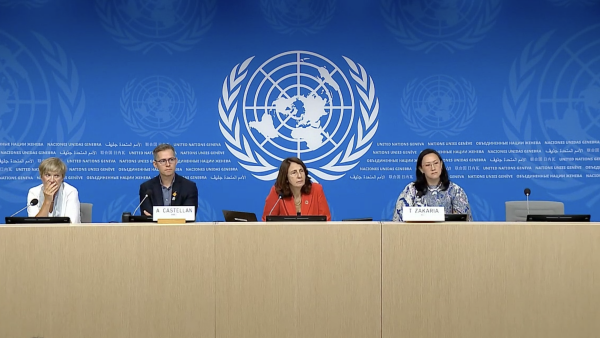
PRESS BRIEFING BY THE UNITED NATIONS INFORMATION SERVICE
12 July 2024
Widening Health Catastrophe in the Democratic Republic of the Congo
Dr. Adelheid Marschang, Senior Emergency Officer, World Health Organization (WHO), said the current situation in the Democratic Republic of the Congo (DRC) was catastrophic. In the past months, the DRC had faced escalating conflict and violence, leading to mass displacement, widespread disease, gender-based violence and severe mental trauma, particularly in the eastern part of the country.
The DRC now had the highest number of people in need of humanitarian aid in the entire world, with 25.4 million people affected. Despite this, it remained one of the most underfunded and forgotten crises.
Around 7.4 million people were displaced, with 2.8 million in North Kivu alone. These mass movements of people were overwhelming water and sanitation systems and placing an additional burden on the population’s scarce resources.
As a result, people were facing outbreaks of cholera, measles, meningitis, mpox and plague, all exacerbated by severe flooding and landslides affecting some parts of the country. This year so far, over 20,000 cases of cholera and close to 60,000 cases of measles had been reported, with actual numbers likely to be higher due to limited disease surveillance and data reporting.
Armed conflict and displacement were the main drivers for food insecurity. According to the latest Integrated Food Security Phase Classification (IPC) Chronic Food Insecurity report, about 40 per cent of the population - 40.8 million people – were facing serious food shortages, with 15.7 million facing severe food insecurity and higher risk of malnutrition and infectious diseases. If immediate action was not taken to address basic needs in the DRC, over one million children would suffer from acute malnutrition.
Health facilities had been overwhelmed, with an up to six-fold increase in patients in some facilities. They were having to treat severe injuries and health workers were traumatised.
WHO was committed to serving the people of the DRC. So far this year, it had reached 460,000 people with emergency health services in conflict-affected areas. To support the cholera response, it used a water, sanitation, and hygiene (WASH) for health approach, providing surveillance and case tracing, water testing and chlorination, sample transportation and testing, supply delivery for prevention and treatment, and clinical management of the construction of treatment centres and water points in displaced people camps. It was working closely with rapid response teams to reach the affected populations.
Humanitarian access remained severely constrained by the military presence around internally displaced person sites and health facilities, bureaucratic impediments, and roadblocks, which were disrupting aid delivery where it was most needed.
WHO was calling for sustained and unimpeded access and urged the relevant parties to work together to restore peace, a first step towards improving the mental and physical health for all people of the DRC.
In response to questions, Dr. Marschang said there had been acute malnutrition as a result of widespread food insecurity in conflict areas in the DRC for decades now, but there was now an escalation compounded by floods. This was forcing farming families to leave their crops and move to safety, exacerbating food security. The prospects for next year would be even worse if the current situation were to continue.
Malnutrition was severely affecting pregnant women, lactating mothers, and children, who needed clinical care with specialised supplies. Health workers needed to be able to work in safety to provide the long-term treatment that pregnant women required. Mothers could not find food, as it was hard to set up predictable food markets.
A very high proportion of those who were malnourished – one million out of 6.9 million – were children. WHO was treating malnourished children, whose immune system and cerebral ability was weakened. Malnutrition affected how children grew and harmed their prospects in life. WHO needed to inform communities about where health treatment was available, and for this, it needed better access to crisis-affected regions.
There had been an acute deterioration in the situation since February of this year. International partners needed to support peaceful solutions and convince armed groups to allow humanitarian access to affected areas. Despite the difficult environment, WHO was committed to providing support, but needed better access.
Mental health support was one of the areas that most needed funding. WHO hoped to scale up funding for this area to support people affected by sexual and gender-based violence. Verification and control of communicable diseases was also a key priority. WHO was working to collect and test disease samples to gain a better picture of outbreak risks. Funding was also needed to distribute medicines and coordinate health partners at the international, national, and local levels.
The multi-agency humanitarian response plan for 2024 aimed to assist 8.7 million people and required 2.6 billion USD. It was currently only 16 per cent funded, although the needs were increasing exponentially. The United Nations Organization Stabilization Mission in the Democratic Republic of the Congo (MONUSCO) had disengaged from South Kivu but was still present in North Kivu, in the east of the country and in Ituri. The security situation had been discussed in a Security Council briefing earlier this week, which raised concerns that the risk of a security vacuum could increase further, leading to more victims of displacement and the continuation of the vicious cycle of violence.
Mpox remained a global threat and the outbreak of mpox in the DRC showed no signs of slowing, with more than 11,000 cases and 445 deaths reported this year. Children were most affected. WHO supporting the DRC and South Africa to respond to the situation and conduct surveillance. It could be difficult to contain the disease if the security situation was not addressed. WHO had observed a new strain of the disease that transmitted only between humans and was being transmitted to children.
International Day to Combat Sand and Dust Storms
Clare Nullis for the World Meteorological Organization (WMO) said it was cold and wet in Switzerland and some parts of France, but in other countries, it was very hot right now. There were heatwaves in the Balkans and western United States. June this year was the 13th consecutive hottest month on record, with record-high sea level temperatures for the 15th consecutive month.
Today was the International Day of Combating Sand and Dust Storms. WMO was taking part in various activities to commemorate the day. It had just issued its annual Airborne Dust Bulletin, which reported that the global average dust concentration was slightly lower in 2023 than in 2022, but higher than the long-term average. Every year, about two 2,000 million tons of dust entered the atmosphere. Airborne dust darkened skies and affected our ecosystems, economies, weather, and climate. This was a natural process but was affected by poor land and water management and climate change. Methods for measuring dust had improved in recent years, due to the progress of numerical models and observation systems.
The WMO Sand and Dust Storm Warning Advisory and Assessment System (SDS-WAS), set up in 2007, strived to improve warnings through dedicated regional centres and combined research and operational work.
Sara Basart, Scientific Officer, World Meteorological Organization (WMO), said international efforts were growing to promote sustainable practices and mitigate the impacts of sand and dust storms. In 2017, the General Assembly urged an inter-agency global response to these storms. The United Nations Coalition on Combating Sand and Dust Storms, established in 2019, included 19 United Nations and non-United Nations organizations to foster global action. Within the Coalition, WMO through the SDS-WAS was leading forecasting and early warning activities. The Coalition was facilitating the observance of the International Day of Combating Sand and Dust Storms, which aimed to raise awareness of the storms and promote health, sustainable land and water management, food security, climate resilience and sustainable livelihoods.
Changes in the land environment were having implications on the occurrence and intensity of sand and desert storms. The most recent Airborne Dust Bulletin presented an overview of the phenomenon. It addressed in detail extreme events that happened last year in Asia. The Commission had observed that the frequency of extreme storms had increased in the last two years, particularly in winter in Europe. Last month, a severe dust storm in Greece had led to the closure of airports and other problems in Athens.
The International Day of Combating Sand and Dust Storms highlighted the current economic impacts of these storms, including in areas where they were formerly uncommon, such as Iceland and Scandinavia. Today was a day for promoting actions for combatting the impacts of this natural but also human phenomenon.
In response to questions, Dr. Basart said that drought in China and in the Maghreb had caused dust storms to form in 2023. Increases in sea surface temperature led to changes in atmospheric patterns, which were affecting dust storm movements.
Sudan Talks
In response to questions, Alessandra Vellucci said that talks on the situation in Sudan, convened by the Personal Envoy of the United Nations Secretary-General on Sudan, Ramtane Lamamra, and an integrated technical team, had been taking place from yesterday in Geneva, including in the Palais des Nations. It was not clear how long talks would last, but they were continuing today. The talks were being convened in proximity format, so the Personal Envoy and his team were engaging with each party separately.
The talks were based on the mandate of two Security Council resolutions on the situation in Sudan, the first of which, 2724, addressed regional peace efforts, and the second, 2736, addressed an immediate cessation of hostilities and a resolution of the conflict through dialogue. The talks were discussing measures to ensure the distribution of humanitarian assistance to all Sudanese people and options to ensure the protection of civilians across Sudan. The discussions were seeking to identify avenues for advancement of the measures including through possible local ceasefires, as per UNSC’s resolutions.
The two delegations were comprised of senior representatives from both warring parties. Both parties were in Geneva, but one had not engaged with the Personal Envoy yesterday. The Personal Envoy had invited both parties to engage today. The United Nations urged all parties to participate in discussions to address the situation in Sudan, which was deteriorating by the day. UNIS would keep journalists informed about the progress of talks. There were no current opportunities for media coverage of the talks.
Announcements
Zeina Awad for the International Labour Organization (ILO) said that on 24 July, ILO and the World Bank would release a working paper on artificial intelligence and Latin America. It would assess how artificial intelligence and the digital divide was affecting the world of work in the region.
A second ILO report due to be released in July would examine the effects of heat stress and climate change on work in different regions, looking into the cost for economies of not implementing occupational health and safety measures to protect workers from climate change.
On 29 July, a working paper on disability and the labour market would be released, in which ILO would examine how disability was affecting a number of indicators, such as the wage gap and labour participation rates.
On 8 August, a global report on youth unemployment would be released, which investigated regional youth employment rates and rates of youth who were not in employment, education, or training (NEET).
The International Labour Organization had sent a test email from newsroom@ilo.org to ensure that journalists were receiving emails from ILO. Journalists who had not received the email but wished to join the mailing list should contact awad@ilo.org.
Alessandra Vellucci, Director of the United Nations Information Service (UNIS) in Geneva, said today was the last day of the 56th session of the Human Rights Council. The Council would today consider three draft resolutions for adoption today on human rights in the context of HIV and AIDS, accelerating progress towards preventing adolescent girls’ pregnancy, and the elimination of all forms of discrimination against women and girls. Pakistan, on behalf of the Organisation of Islamic Cooperation, informed the Council secretariat yesterday evening that they had withdrawn their draft resolution (L.20/Rev 1) on “Countering religious hatred constituting incitement to discrimination, hostility or violence.” So far, the Human Rights Council has adopted a total of 22 resolutions. Nineteen of them were adopted without a vote. The 57th session of the Human Rights Council would begin on Monday, 9 September 2024.
Starting on Monday, 15 July, the Palais des Nations would host the 16th edition of the week-long Nelson Mandela World Human Rights Moot Court Competition. The event coincided with Nelson Mandela International Day, which was celebrated on 18 July. Forty-eight students from 24 universities and 17 countries would participate in this unique competition dedicated to human rights. The Moot Court was an event organized by the Centre for Human Rights of the University of Pretoria with the support of the Human Rights Council Secretariat.
The Human Rights Committee was continuing this morning its review of the report of the Syrian Arab Republic. The Committee against Torture would begin its consideration of the report of Cote d’Ivoire next Tuesday morning. The Conference on Disarmament would take up the third and last part of its annual session on 29 July, still under the presidency of Noel White of Ireland.
Today, in New York, the Ad-Hoc Committee of the General Assembly on Voluntary Contributions to the United Nations Relief and Works Agency for Palestine Refugees in the Near East (UNRWA) would be held. United Nations Secretary-General António Guterres was expected to make a statement on the critical role of UNRWA and UNRWA Commissioner-General Philippe Lazzarini would also make a statement.
15 July was Youth Skills Day and the Secretary-General had released a statement on the important day.
***
Similar Stories
1
1
1
Statements , Press Conferences | OHCHR
1
1
1
Press Conferences | UNHCR , UNICEF , IFRC , OHCHR , UN WOMEN , IOM , OCHA , WHO
UNHCR – ExCom Meeting, UNICEF – Nepal Recovery, IFRC – Flash Floods, WHO – Mental Health, IOM – South Sudan Floods, OCHA – DRC Humanitarian aid, UNHCR – Sahel Displacement, UNICEF – Yemen Update, IOM – Gaza Shelter, UN Women – Gaza Women, OHCHR – Arrests and detentions of Syrians by Israeli force
2
1
2
Press Conferences | UNCTAD
Presentation of the Trade and Developement Report 2026
Embargoed until 9 October 2026 at 11 a.m. (Geneva Time)
UNCTAD: UNCTAD’s flagship report finds that governments increasingly use industrial, trade, financial and technology policies to pursue economic and national security objectives. Market access and the ability to move into higher-value activities now depend more heavily on technology, finance and geopolitics.
1
1
1
Press Conferences | UPU
Release of the State of the Postal Sector Report 2026
1
1
1
Press Conferences | IOM , ITU , UNECE , UNICEF , WHO , WMO
UNICEF: Ebola, DRC - children orphans or separating them from parents and caregivers; IOM: Humanitarian needs in Djibouti amid arrivals from Yemen and increased migrant movements; WHO: Darfur, scale of health needs far exceeds available resources; WMO co-sponsored Global Heat Forum, Bangkok, monthly Global Seasonal Climate Update; UNECE: UN Forum of Mayors; ITU Plenipotentiary Conference 2026; WHO: child and adolescent obesity guidelines and new global roadmap to tackle pregnancy hypertension, a leading cause of maternal mortality
1
1
1
Press Conferences | OCHA , UN WOMEN , UNHCR , WFP , WHO , WTO , UNEP
OCHA – $160M CERF allocation to 12 underfunded crises; UNHCR – 5.8M refugee children remain out of school amid funding cuts; UN Women – Middle East escalation and food security among women/girls; WHO – Gaza supplies and overall situation; WFP – Yemen food insecurity and impact on global hunger ; UNEP - First International Conference of the Global Framework on Chemicals in Geneva | 16-20 November 2026
1
1
1
Press Conferences | UNHCR , WHO
Yemen's health system nears collapse amid conflict, causing rising casualties and medicine shortages.
1
1
1
Press Conferences | HRC
Update by the Expert Mechanism to Advance Racial Justice and Equality in Law Enforcement
1
1
1
Press Conferences | WIPO , WHO , UNICEF , UNHCR , IOM , WFP , FAO
WIPO Global Innovation Index 2026 launch and press conference, WHO Composition of influenza vaccines for the 2027 Southern Hemisphere flu season, UNICEF Yemen hunger and malnutrition; UNHCR Sudan displacement into Chad; IOM Ebola and population movements in DRC; WFP emergency food assistance in Nepal; and FAO food loss and waste.
2
1
2
Press Conferences | UNCTAD
Gaza reconstruction needs reach $71.5 billion as Palestinian economy and public finances face severe strain. Latest UNCTAD report documents the loss of decades of development gains, economic collapse in Gaza and tightening economic constraints in the West Bank.
The report identifies three immediate priorities: transferring withheld Palestinian revenues, safeguarding the banking system and aligning reconstruction support with the documented scale of damage and economic losses.
1
1
1
Press Conferences | HRC
Press conference on the situation of human rights in Nicaragua by the UN Group of Human Rights Experts
1
1
1
Press Conferences | ITU , UNHCR , WHO , WMO
YEMEN - UNHCR: Escalating conflict in Yemen could fuel more displacement, refugee movement
CLIMATE - WHO / WMO: Health and Climate impact of El Niño