

The United Nations Office at Geneva
Multimedia Newsroom
Press Conferences | OHCHR , UNITED NATIONS
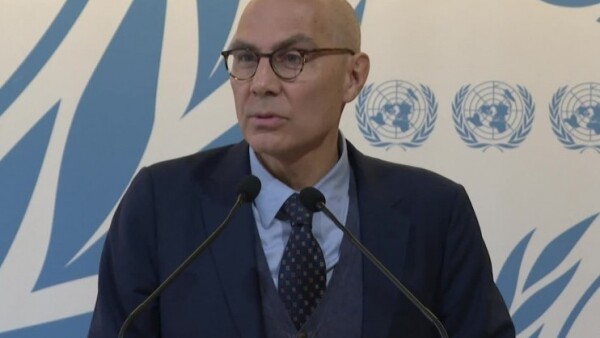
Media Stakeout - UN High Commissioner for Human Rights Volker Türk -16 November 2023
Geneva, 16 November 2023
Excellencies,
A conflagration of violence has been unleashed in the Occupied Palestinian Territory – both in Gaza and the West Bank – as well as in Israel. Given the magnitude of the challenges, I thought it important to provide this informal briefing following my mission to Egypt and Jordan last week, and to offer my recommendations. I am grateful to both countries for having facilitated my visit.
I met with senior officials of both Egypt and Jordan, as well as the State of Palestine, and the Secretary-General of the Arab League; many UN colleagues, and representatives of Palestinian, Egyptian, Jordanian and Israeli civil society. I briefed journalists in Cairo and in Amman, with statements highlighting my key concerns and recommendations. I have also asked to visit Israel and the Occupied Palestinian Territory – a visit I consider very important.
I visited Rafah and El Arish, where I was struck by the horrific wounds of many patients at the hospital, including numerous children. I have also heard from a number of Israelis about their anguish, including families of the children and adults abducted by Hamas and other Palestinian armed groups.
Rarely have I heard such disturbing testimony about the catastrophic harm that ordinary people have endured, and which continues to mount. And never in my career of working in many crisis situations around the world have I met such an outpouring of fear, anger and despair.
The people of Gaza, who for years have been profoundly impoverished behind barbed wire fences, are enduring bombardment by the Israeli Security Forces of an intensity rarely experienced in this century.
One in every 57 people living in the Gaza strip has been killed or wounded in the past five weeks, according to figures from the Gaza Ministry of Health. Over 11,100 have been killed, more than 4,600 of them children. 102 of those killed were UN staff members: people whose only goal is to assist civilians. More than 26,000 people have been injured, many severely. And at least 2,000 more people are presumed to be trapped under the rubble of completely destroyed neighbourhoods, where there is no capacity to reach or rescue them. An entire population is being deeply traumatised.
In Israel, according to the authorities, 1,200 people, including many children, were killed in horrific attacks by Hamas and other armed groups on 7 and 8 October. 239 people, including children, were captured and taken to Gaza. And the nation has been thrown into shock.
It is apparent that on both sides, some view the killing of civilians as either acceptable collateral damage, or a deliberate and useful weapon of war. This is a humanitarian and human rights crisis. It represents a breakdown of the most basic respect for humane values. The killing of so many civilians cannot be dismissed as collateral damage. Not in a kibbutz. Not in a refugee camp. And not in a hospital.
As bombardment continues by air, intense urban warfare is also underway. In the very few hospitals that are still functioning, doctors operate on screaming children without anaesthetic, using mobile phones for light. WHO has recorded at least 137 attacks on health care in Gaza, with especially severe impact on Al-Shifa Hospital in recent days, where newborns on life support are dying due to power, oxygen, and water cuts, while many other patients of all ages are at risk – as well as medics, and people sheltering on the hospital grounds. And yet international humanitarian law requires special protection to medical units at all times, so that they can continue their life-saving work.
Many ordinary people have been forced to move south, seeking some kind of safety. They are carrying elderly family members, and terrified, sometimes wounded children, moving slowly on a bomb-cratered road. Others are unable to undertake the journey: hundreds of thousands of people – including many children, wounded, and people with disabilities – reportedly remain trapped in northern Gaza, where humanitarian access has become impossible.
The total depletion of fuel supplies is imminent, according to UNRWA, and it would be catastrophic across all of Gaza – leading to the complete collapse of water, sewage and crucial healthcare services, and ending the trickle of humanitarian assistance that has been permitted to date. Massive outbreaks of infectious disease, and hunger, seem inevitable.
Current proposals for a so-called ‘safe zone’ are untenable: the zone is neither safe nor feasible for the number of people in need. I refer you to the IASC statement that will be coming out shortly.
Excellencies,
No-one is above the law, and international humanitarian law is clear.
All parties to every conflict must, at all times, distinguish between civilians and combatants, and between civilian objects and military objectives. Attacks directed at civilians or protected civilian objects – hospitals, schools, and the markets and bakeries that constitute a lifeline – are prohibited. Indiscriminate attacks – for example, aiming indiscriminate projectiles into southern Israel – are prohibited. Attacks where the likelihood of civilian death, and damage to protected objects, is disproportionate to the concrete and direct military advantage – as constantly risked by Israel’s use of explosive weapons with wide-area effect in densely populated areas of Gaza – are also prohibited. Forced displacement is prohibited. The taking and holding of hostages is prohibited, as is any use of civilians to shield locations from military operations. Collective punishment – as in the case of Israel’s blockade and siege imposed on Gaza – is prohibited.
Extremely serious allegations of multiple and profound breaches of international humanitarian law, whoever commits them, demand rigorous investigation and full accountability. Where national authorities prove unwilling or unable to carry out such investigations, and where there are contested narratives on particularly significant incidents, international investigation is called for.
And it must be clear that breaches of international humanitarian law – even war crimes – committed by one party do not, ever, absolve the other from compliance with the clear principles of the law of war.
Excellencies,
The crisis extends well beyond Gaza. I am deeply concerned about the intensification of violence and severe discrimination against Palestinians in the occupied West Bank, including East Jerusalem. In my view, this creates a potentially explosive situation, and I want to be clear: we are well beyond the level of early warning. I am ringing the loudest possible alarm bell about the occupied West Bank.
As I warned last Friday, settler attacks on Palestinians are increasing, and Israeli security forces have stepped up their use of military weaponry in law enforcement operations. Since the beginning of October, at least 190 Palestinians have been killed by Israeli security forces or by settlers. My Office will be issuing a report on these issues, including conditions of detention.
I also share the deep sense of foreboding of many of my interlocutors about the risk of spill over into the wider Middle East region, if the current trajectory continues.
This crisis is another global shock to our multilateral system – polarising it further, and creating deeper fractures, with unbearable consequences for the solutions that humanity so urgently needs. We must not allow this to happen. Polarisation is a trap. Every one of us needs to strive to find common ground, and a solution.
Let me be clear. The outbreak of conflict is always a failure: A failure to find a peaceful solution. A failure of prevention. A failure to uphold human rights. I feel this deeply. The failure, in this case, has been long-standing, and many parties could count their part of responsibility in it.
But every conflict that has been enduringly resolved, has achieved that resolution through the advancement of justice, accountability and human rights.
Warnings by my Office, and others, about the explosive situation in the Occupied Palestinian Territory, in particular Gaza; our careful documentation of human rights violations over many years; and our recommendations for de-escalation, accountability and justice have been ignored – not only in Israel and the Occupied Palestinian Territory, but by States with influence on the parties to this crisis.
The voice of reason, our work to report and document violations, and our advocacy for human rights, will persevere until it is heard.
Today, among both Israelis and Palestinians, entirely separate narratives are building up, parallel to each other and with no connection between them. Profound historical traumas have been revived. I plead for everyone to recognise and acknowledge this depth of pain, and the reality of the humanity and the suffering of the other. This is perhaps my most important recommendation: it is essential that all parties acknowledge that all human lives have equal value.
A vortex of disinformation and dehumanising rhetoric is tugging people away from reason and humanity, blocking the work of identifying and clearing the way out and forward.
We must not let rage submerge our moral compass. We must not lose our grip on reality to the myth that pain can be eradicated by unleashing it on a scapegoat. We must insist on the truth. And we must continue to insist on the humanity, and the value, of every life that is affected or destroyed in this fighting.
My Office is not partisan. But yes: I am taking sides. I am on the side of every civilian, Palestinian or Israeli, who is harmed, or who lives in fear. Every one of them has exactly the same rights to live and thrive in peace and in freedom. That is the promise of the Universal Declaration of Human Rights.
Who can win a war in which so many children have been killed? Only extremism. The extremism that will continue grinding up the bodies and the future of the children of both sides – Palestinians and Israelis – and their children's children, until their future is only despair and bloodshed.
What kind of societies will emerge from this conflict? And where is the way out?
Israelis' freedom is inextricably bound up with Palestinians' freedom. Palestinians and Israelis are each others' only hope for peace.
Last night, the Security Council adopted resolution 2712, calling for “urgent and extended humanitarian pauses and corridors throughout the Gaza Strip”, among other key demands on the parties. Such action is critically necessary.
I urge the parties to give effect, immediately, to the Council’s calls. And I urge all those with responsibility to step back from this devastating escalation of death, destruction and grief.
All States with influence must seek common ground, to disempower extremists by offering hope; and to build an enduring peace, through justice and the guarantee of equal rights.
There must be an end to grave human rights violations, notably against children.
All forms of collective punishment must come to an end. All hostages must be released.
International humanitarian and human rights law must be immediately and fully respected, including the principles of necessity, distinction, precaution and proportionality.
There must be a ceasefire on humanitarian and human rights grounds, and an end to the fighting – not only to deliver urgently needed food and water, but to create the space for a path out of this horror.
Rapid and unimpeded humanitarian assistance throughout Gaza, including fuel, and at the scale required, is urgently needed, and must be facilitated – including through Israeli crossings such as Kerem Shalom. My Office will remain deeply engaged, and I stress the importance of full access to Israel and the Occupied Palestinian Territory, including Gaza, for my Office, to ensure full and independent monitoring and documentation, and to coordinate protection work.
I further urge Israeli authorities to take immediate measures to ensure that the security forces comply with their obligations as an occupying power to protect Palestinians in the occupied West Bank, including from violence by settlers. Continued, widespread impunity for such violations must stop.
Without genuine accountability, contested narratives cannot be resolved; and people will be unable to contemplate a shared, common future alongside each other. Accountability is the key to opening the possibility of a genuinely different reality.
We have issued numerous detailed recommendations to address the underlying drivers of the Israeli-Palestinian conflict, most recently in my speech to the Human Rights Council in March. It is urgent that their implementation begin.
In the fog of war it is particularly important to support including with financial resources, civil society, who act as eyes and ears.
Finally, it is clear that the Israeli occupation must end. It is essential to ensure the rights of Palestinians to self-determination and to their own State. And it is essential to acknowledge that Israel has a right to exist.
My Office will continue to do our utmost to assist all parties to step back from the precipice to which extremism and violence have led. Our strongest assets will remain our principled independence, and our consistent standing on the international laws and standards that can ensure enduring peace, through respect for every human life.
Similar Stories
1
1
1
Press Conferences | UN WOMEN , WFP , WHO
UN WOMEN: Sudan Women and girls one year after the fall of El Fasher; increasing drone attacks across the country; WFP: DRC - Ebola spreads to eighth DRC province as WFP delivers food, builds treatment centres and keeps supplies moving; WHO - Update on Ebola (Bundibugyo Virus Disease)
1
12
1
1
Press Conferences , Images | UNOG
Closing Press Conference following the Sixth Consultative Meeting on Enhancing Coordination of Peace Initiatives and Efforts in Sudan
2
17
1
2
Edited News , Press Conferences , Images | OCHA , WMO
Two UN agencies teamed up on Wednesday to issue an appeal for immediate assistance to help communities already being impacted by the strongest El Niño on record.
1
1
1
Press Conferences | CITES
Wildlife trade and conservation policy discussions at the 81st meeting of the CITES Standing Committee (SC81)
1
1
1
Press Conferences | UNHCR , UNCTAD , WMO , OCHA , UNICEF , WHO
UNHCR Hungary’s 1956 Refugee Crisis: 70 Years On, UNCTAD World Investment Forum 2026, Doha, WMO Greenhouse Gas Bulletin and Climate Update for COP31, OCHA Afghanistan: Malnutrition, Girls’ Education and Recovery, UNICEF Yemen: Child Malnutrition and Unsafe Water in Taiz, WHO Inequalities in Noncommunicable Diseases and Risk Factors
1
1
1
Press Conferences | UNHCR
End of UNHCR's 77th Annual Executive Committee (ExCom) meeting week
1
1
1
Press Conferences | UNICEF , IOM , UNHCR
UN Special Assistant to the Personal Envoy Office (SUDAN): Peace Initiatives and Efforts in Sudan; UNICEF: Dire situation of children in Gaza; IOM: Damaged Homes and Energy Attacks Risk Displacing Ukrainians for this winter; UNHCR: update on EXCOM week
1
1
1
Press Conferences | IOM , UNDRR
UN stresses importance of household preparedness for disaster risk reduction.
1
1
1
Statements , Press Conferences | OHCHR
1
1
1
Press Conferences | UNHCR , UNICEF , IFRC , OHCHR , UN WOMEN , IOM , OCHA , WHO
UNHCR – ExCom Meeting, UNICEF – Nepal Recovery, IFRC – Flash Floods, WHO – Mental Health, IOM – South Sudan Floods, OCHA – DRC Humanitarian aid, UNHCR – Sahel Displacement, UNICEF – Yemen Update, IOM – Gaza Shelter, UN Women – Gaza Women, OHCHR – Arrests and detentions of Syrians by Israeli force
2
1
2
Press Conferences | UNCTAD
Presentation of the Trade and Developement Report 2026
Embargoed until 9 October 2026 at 11 a.m. (Geneva Time)
UNCTAD: UNCTAD’s flagship report finds that governments increasingly use industrial, trade, financial and technology policies to pursue economic and national security objectives. Market access and the ability to move into higher-value activities now depend more heavily on technology, finance and geopolitics.
1
1
1
Press Conferences | UPU
Release of the State of the Postal Sector Report 2026