

The United Nations Office at Geneva
Multimedia Newsroom
Press Conferences | OHCHR , UNOG , WHO , WMO , WTO
VIRTUAL PRESS BRIEFING – Friday, 30 June 2023
PRESS BRIEFING BY THE UNITED NATIONS INFORMATION SERVICE
30 June 2023
Human rights situation in Myanmar
Ravina Shamdasani, for the Office of the High Commissioner for Human Rights (OHCHR), informed that the OHCHR was issuing today a report on the human rights situation in Myanmar. The already dire situation on the ground had been compounded by the military forces’ restrictions on aid imposed in the aftermath of Cyclone Mocha in May, bringing further suffering and misery to wide swathes of the population in the west and northwest of the country. As the report made clear, intentional obstruction or denial of humanitarian assistance might amount to gross violations of international human rights law, and serious violations of international humanitarian law.
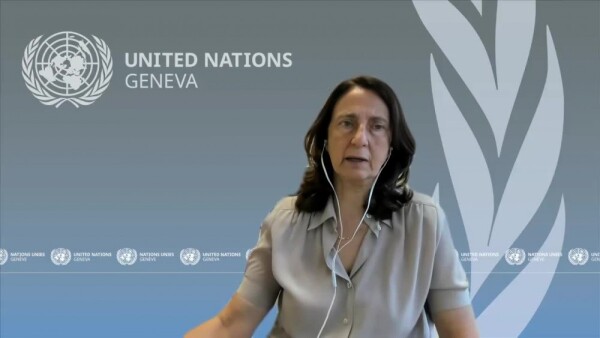
James Rodehaver, Chief of the Myanmar Team at the Office of the High Commissioner for Human Rights (OHCHR), speaking from Bangkok, informed that the military was applying the “four cut” strategy: cutting off access to food, finances, intelligence, and ability of its opponents to recruit. The military viewed the population at large as their opponents. The military had first used all administrative restrictions against their opponents and civil sector, forbidding them to operate legally. Military means, including heavy weaponry and air strikes, were used to sow fear among the population. Food stores and crops were also burned, medical facilities were destroyed, and medical workers directly targeted and killed. The new report highlighted the results of such attacks – especially the massive impact on health and food. In the aftermath of the natural disaster in May, large parts of the population had a very limited access to humanitarian aid. Some people reported not having been allowed to grow or buy food. A number of interviewees said that if you were delivering assistance, you could be considered as being associated with illegal groups and punished for that. At least 40 local aid providers had been killed, 28 had been wounded, and well over 200 arrested.
Mr. Rodehaver explained that the report did not address the situation in the aftermath of the cyclone Mocha, but those aspects would be covered in the High Commissioner’s presentation to the Human Rights Council the following week. The denial and restrictions of aid was part of a long-standing strategy by the military.
OHCHR report is available here.
Responding to questions, Mr. Rodehaver said that the UN Resident Coordinator in Myanmar had explained that the earlier-agreed food assistance had reached an estimated 300,000 people in the Rakhine State. Now, six weeks since the cyclone Mocha, it was definitely not the time to instrumentalize or politicize delivery of humanitarian aid. Some of the killed aid workers seem to have been deliberately targeted, said Mr. Rodehaver. One of the purposes of the report was to show, in a very evidence-based way, what tactics the military was using.
Database of business enterprises in the occupied Palestine
Ravina Shamdasani, for the Office of the High Commissioner for Human Rights (OHCHR), issued an update to the database of business enterprises involved in certain activities relating to settlements in the Occupied Palestinian Territory. Mandated by a 2016 resolution of the Human Rights Council, the OHCHR had issued a report in 2018 on the methodology to be used, and then a report containing the database itself in 2020.
The 2020 report had identified 112 business entities which were believed to be involved in one or more of the specific activities referenced in the HRC resolution. While the resolution called for annual updating, no regular resources were provided for that purpose, limiting OHCHR ability to undertake further work. With limited funds, and on an exceptional basis, in July 2022, the OHCHR had sent each of the 112 entities a letter, informing them that it was reviewing the database, on the basis of available information. OHCHR had invited them to provide any further relevant information on their structure, ownership, or involvement with the listed activities, and had received responses from 13 enterprises, and then engaged in dialogue with some companies that requested it. Following this review, the OHCHR had found reasonable grounds for the removal of 15 business enterprises on the basis that they were ceasing or were no longer involved in one or more of the listed activities in the OPT.
The updated database is available here.
Answering questions from the media, Ms. Shamdasani reiterated that no regular budget resources had been allocated for the OHCHR to update the database. The latest update had been prepared with extrabudgetary resources. Ms. Shamdasani said that it was no secret that the OHCHR was frequently under pressure by one side or another. OHCHR had only re-examined the 112 business entities on the original list and had not looked into additional companies.
Deteriorating health situation in the eastern Democratic Republic of the Congo
Dr. Jorge Castilla, Senior Emergency Officer for Humanitarian Emergency Interventions
in Fragile, Conflict, and Vulnerable Settings at the World Health Organization (WHO), speaking from Kinshasa, said that since March 2022, 2.8 million people had been forced from their homes in North Kivu, South Kivu and Ituri provinces due to a surge in attacks from armed groups. DRC now had 6.3 million internally displaced people, the highest number in any African country, which were left more at risk of disease outbreaks and acute malnutrition.
The country’s health system and available resources were under pressure due to concurrent outbreaks of COVID-19, measles, polio and mpox but also yellow fever, cholera, and malaria, which were also on the rise due to recurrent natural disasters and lack of access to safe water and sanitation for being on the move. Since December 2022, close to 25,000 cholera cases and more than 136,000 measles cases had been reported in eastern DRC, including 2,000 measles deaths recorded so far this year. The combination of measles and malnutrition had severe health impact on children under 5 years of age, putting them at risk of dying with lack of access to adequate treatment. As of 12 June 2023, a total of 24,562 cholera cases and 156 deaths had been reported. Hunger and malnutrition were growing, forcing the displaced to sporadically return to their areas of origin to collect resources, exposing them to further violence and to mental health and psychosocial strain. Close to 26 million people were facing acute food insecurity in 2023, the world's highest number of food insecure people.
WHO and partners had stepped up their emergency assistance in the eastern provinces of North Kivu, South Kivu, and Ituri, but also in Tshopo, Mai-Ndombe, and Kasai, focusing, among other areas, on increasing access to services such as mental health, gender-based violence and vaccination, disease early warning and surveillance of to prevent outbreaks. More information about the UN assistance scale-up can be found here.
Responding to questions, Dr. Castilla said that the WHO was asking its donors both for more flexibility and to provide a necessary scale-up. Since the eruption of events in March 2022, which had set off the latest wave of displacement, ever more resources had been needed for the country, he explained. An average of 1,000 cholera cases per week were registered, he explained, and North Kiwu accounted for half of the recorded cases.
Killing of a young person and riots in France
Ravina Shamdasani, for the Office of the High Commissioner for Human Rights (OHCHR), stated that the OHCHR was concerned by the killing of a 17-year-old person of North African descent by police in France on 27 June. OHCHR noted that an investigation had been launched into alleged voluntary homicide. This was a moment for the country to seriously address the deep issues of racism and discrimination in law enforcement. Ms. Shamdasani also emphasized the importance of peaceful assembly. OHCHR called on the authorities to ensure that police’s use of force to address violent elements in demonstrations always respects the principles of legality, necessity, proportionality, non-discrimination, precaution and accountability. Any allegations of disproportionate use of force had to be swiftly investigated.
Answering questions, Ms. Shamdasani said that in December 2022, the UN Committee on the Elimination of Racial Discrimination had already expressed its deep concern over the frequent use of identity checks and police stops that seemed to disproportionately target persons of certain minority groups, such as those of African descent and Roma.
Special Rapporteur report on Guantanamo
Answering a question on the latest report on the Guantanamo detention centre by Fionnuala Ní Aoláin, UN Special Rapporteur on the promotion and protection of human rights and fundamental freedoms while countering terrorism, Ms. Shamdasani said that OHCHR would not endorse reports by Special Rapporteurs as the latter were mandated by the Human Rights Council and were independent – although OHCHR staff would provide them with support. The findings of the report were serious, and its recommendations were important. OHCHR had repeatedly expressed its concerns over the human rights abuses in the Guantanamo detention center and had repeatedly called for its closure.
Support to healthcare delivery in Sudan and Chad
Ewan Watson, for the International Committee of the Red Cross (ICRC), said that ICRC teams in Sudan were witnessing a devastating situation when it came to health care facilities. In Khartoum, only about 20 percent of health care facilities were functioning and the system could collapse despite the impressive efforts of healthcare staff and volunteers. Use of explosive weapons in populated areas had affected access to water and food, and medical supplies. The medical personnel and Red Crescent volunteers were doing the impossible and aiding the hospitals under very difficult circumstances.
Mr. Watson further said in Abeche, in the east of Chad, a surgical team deployed by the ICRC had operated on four patients. Most patients arriving were men with trauma injuries, with over 100 people needing urgent treatment now. Another ICRC surgical team was arriving to Port Sudan. Drugs and other medical supplies were being provided to medical facilities, when the conditions allowed.
Replying to questions, Mr. Watson said that the ICRC was focused on supporting essential services, such as medical care and water pump reparations. ICRC’s role as a neutral intermediary remained of paramount importance.
Ending the peacekeeping mission in Mali
Responding to questions from the media, Alessandra Vellucci, for the UN Information Service (UNIS), said that the UN was in continuous contact with the Malian authorities. Closing down of any peacekeeping mission was a timely, complex process, she explained. The UN Secretariat would take action on decisions of the Security Council.
Announcements
Clare Nullis, for the World Meteorological Organization (WMO), said that the WMO would be releasing its new El Niño update on 4 July, and if there was interest, a small technical briefing could be organized.
On 5 July, the WMO State of Climate in Latin America and Caribbean Report 2022 would be released in Havana, Cuba, part of a series of regional climate reports. Information in Spanish and English would be shared soon under embargo.
Alessandra Vellucci, for the United Nations Information Service (UNIS), informed that on 5 July at 12 noon, the UN Conference on Trade and Development (UNCTAD) would hold a hybrid press conference to present the World Investment Report 2023 – Investing in Sustainable Energy for All. Speakers would be Rebeca Grynspan, UNCTAD Secretary-General, and James Zhan, Director of UNCTAD’s Division on Investment and Enterprises.
Also on 5 July, at 2 p.m., the Independent International Fact-Finding Mission on the Islamic Republic of Iran would hold a press conference on its update to the Human Rights Council. Speakers would be Sara Hossain, Chair of the Iran Fact-Finding Mission, and Shaheen Sardar Ali and Viviana Krstičević, Mission Members.
On 6 July at 2 p.m., there would be a hybrid press briefing by the Special Rapporteur on the Situation of Human Rights in Myanmar, Thomas Andrews.
Ms. Vellucci informed that the Human Rights Committee was concluding this morning the review of the report of Brazil. This afternoon, it would begin the review of the report of Uganda.
The AI for Good Global Summit of the International Telecommunications Union (ITU) would take place in Geneva on 6 and 7 July. On 5 July, from 4 to 6 p.m., journalists were invited to a media preview at CICG. Reporters would be able to meet the tech and the teams behind it for media availabilities in advance of the formal opening. ITU media accreditation was required even with a UN badge for the main events and the media preview. All journalists were strongly encouraged to register in advance.
Fernando Puchol, for the World Trade Organization (WTO), informed that on 3 July at 2 p.m., Trading Services for Development, a joint WTO-World Bank publication, would be released. The event would take place virtually, with the opening remarks by the principals of the WTO and the WB. The embargo on the report, available in the WTO Newsroom, would be lifted on 3 July at 2 p.m.
Similar Stories
1
1
1
Press Conferences | CITES
Wildlife trade and conservation policy discussions at the 81st meeting of the CITES Standing Committee (SC81)
1
1
1
Press Conferences | UNHCR , UNCTAD , WMO , OCHA , UNICEF , WHO
UNHCR Hungary’s 1956 Refugee Crisis: 70 Years On, UNCTAD World Investment Forum 2026, Doha, WMO Greenhouse Gas Bulletin and Climate Update for COP31, OCHA Afghanistan: Malnutrition, Girls’ Education and Recovery, UNICEF Yemen: Child Malnutrition and Unsafe Water in Taiz, WHO Inequalities in Noncommunicable Diseases and Risk Factors
1
1
1
Press Conferences | UNHCR
End of UNHCR's 77th Annual Executive Committee (ExCom) meeting week
1
1
1
Press Conferences | UNICEF , IOM , UNHCR
UN Special Assistant to the Personal Envoy Office (SUDAN): Peace Initiatives and Efforts in Sudan; UNICEF: Dire situation of children in Gaza; IOM: Damaged Homes and Energy Attacks Risk Displacing Ukrainians for this winter; UNHCR: update on EXCOM week

1
1
1
Press Conferences | IOM , UNDRR
UN stresses importance of household preparedness for disaster risk reduction.

1
1
1
Statements , Press Conferences | OHCHR

1
1
1
Press Conferences | UNHCR , UNICEF , IFRC , OHCHR , UN WOMEN , IOM , OCHA , WHO
UNHCR – ExCom Meeting, UNICEF – Nepal Recovery, IFRC – Flash Floods, WHO – Mental Health, IOM – South Sudan Floods, OCHA – DRC Humanitarian aid, UNHCR – Sahel Displacement, UNICEF – Yemen Update, IOM – Gaza Shelter, UN Women – Gaza Women, OHCHR – Arrests and detentions of Syrians by Israeli force

2
1
2
Press Conferences | UNCTAD
Presentation of the Trade and Developement Report 2026
Embargoed until 9 October 2026 at 11 a.m. (Geneva Time)
UNCTAD: UNCTAD’s flagship report finds that governments increasingly use industrial, trade, financial and technology policies to pursue economic and national security objectives. Market access and the ability to move into higher-value activities now depend more heavily on technology, finance and geopolitics.

1
1
1
Press Conferences | UPU
Release of the State of the Postal Sector Report 2026
1
1
1
Press Conferences | IOM , ITU , UNECE , UNICEF , WHO , WMO
UNICEF: Ebola, DRC - children orphans or separating them from parents and caregivers; IOM: Humanitarian needs in Djibouti amid arrivals from Yemen and increased migrant movements; WHO: Darfur, scale of health needs far exceeds available resources; WMO co-sponsored Global Heat Forum, Bangkok, monthly Global Seasonal Climate Update; UNECE: UN Forum of Mayors; ITU Plenipotentiary Conference 2026; WHO: child and adolescent obesity guidelines and new global roadmap to tackle pregnancy hypertension, a leading cause of maternal mortality
1
1
1
Press Conferences | OCHA , UN WOMEN , UNHCR , WFP , WHO , WTO , UNEP
OCHA – $160M CERF allocation to 12 underfunded crises; UNHCR – 5.8M refugee children remain out of school amid funding cuts; UN Women – Middle East escalation and food security among women/girls; WHO – Gaza supplies and overall situation; WFP – Yemen food insecurity and impact on global hunger ; UNEP - First International Conference of the Global Framework on Chemicals in Geneva | 16-20 November 2026
1
1
1
Press Conferences | UNHCR , WHO
Yemen's health system nears collapse amid conflict, causing rising casualties and medicine shortages.