

The United Nations Office at Geneva
Multimedia Newsroom
PRESS BRIEFING BY THE UNITED NATIONS INFORMATION SERVICE
30 May 2023
Conflict in Sudan
Eddie Rowe, World Food Programme (WFP) Country Director in Sudan, speaking from Port Sudan, informed that the first distributions of food assistance to Khartoum had started on 27 May; 15,000 Sudanese had received assistance in the Khartoum area, in the areas controlled by both warring parties. More food assistance had been prepositioned, which was contingent on the security situation; WFP planned to reach at least 500,000 people in Khartoum. The previous week, the WFP had begun distributing food to approximately 4,000 newly displaced people in Port Sudan. WFP had rapidly scaled up support in Sudan to reach 725,450 people so far with emergency food and nutrition assistance in 13 of the country’s 18 states.
Mr. Rowe said that the WFP expected to expand its assistance in other regions as it was quite advanced in negotiating access. WFP estimated that USD 731 million was needed to reach 5.9 million people in the next six months and to provide telecommunications and logistics services to the humanitarian community. WFP urgently called on all parties to enable the safe delivery of urgently needed food aid, especially in Khartoum State where fighting had been raging for six weeks. An estimated 2-2.5 million people in Sudan were expected to slip into hunger in the coming months because of the ongoing violence. This would take acute food insecurity in Sudan to record levels, with more than 19 million people affected, 40 percent of the population.
James Elder, for the United Nations Children’s Fund (UNICEF), said that 13.6 million children in Sudan, more than ever before, required life-saving support. The lives of those children were approaching an abyss. According to reports received by UNICEF, hundreds of boys and girls had been killed, and thousands more had been maimed. Those numbers were coming only from those families who had been able to reach health facilities, explained Mr. Elder. Nutrition services, health services, water provision had all been turned upside down in the country. Time was not a luxury that children in Sudan had, said Mr. Elder. UNICEF called on all parties to protect the children of Sudan and to protect the critical infrastructure on which they depended. UNICEF had launched its USD 838 million appeal to reach 10 million children; this appeal was currently five percent funded. Over 2,300 metric tons of nutrients, water, sanitation, and education supplies had been delivered to immunization services had been maintained across much of the country. Children of Sudan needed a comprehensive peace; in the meantime, UNICEF’s support would continue.
Replying to questions, Mr. Elder explained that the growth of the original humanitarian appeal for children was due to the worsening conditions. Mr. Rowe stressed that access to food had been one of the major challenges for local communities. WFP had temporary storages which made it possible for them to provide such assistance. About 17,000 metric tons of food had been lost to looting across the country, especially in the Darfurs, informed Mr. Rowe. Looting was not unique to Sudan, said Mr. Elder, who could not confirm the exact numbers of children killed and wounded.
Tarik Jašarević, for the World Health Organization (WHO), said that the WHO could verify 45 attacks on health care so far, which had led to eight deaths and 18 injuries. He emphasized that attacks on health care were against international humanitarian law and had to stop. Federal Ministry of Health of Sudan provided information that, until 25 May, there had been a total of 5,500 injuries and 850 deaths.
Impact of flooding in Somalia on children and families
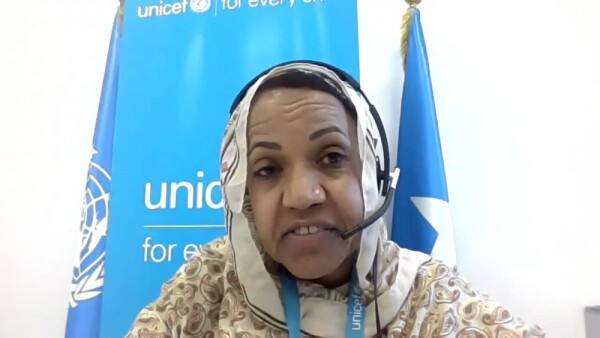
Wafaa Saeed, United Nations Children’s Fund (UNICEF) Representative in Somalia, speaking from Mogadishu, stated that Somalia had gone through five consecutive seasons of failed rains. A new famine had thankfully been averted, but the arrival of rains had displaced more than 400,000 people. Up to 1.6 million people could be affected throughout the current rainy season, which had led to floods in certain regions. Some communities could only be reached by boat, said Ms. Saeed. It was unfortunate that the Somalia humanitarian response plan was only 26 percent funded at the time being.
Ms. Saeed stressed that Somalia’s story and the challenges facing the generations of children was first and foremost a climate emergency, including more frequent and severe droughts and floods. Humanitarian funding had to be flexible and be accompanied by localized solutions. Somalia needed to have access to climate financing, so that it could break from the cycle of one climate emergency after another. However, challenging the situation could be, success was possible in Somalia, which the aversion of latest famine proved. Somalia and other countries in the region were just one rainy season away from another catastrophe, she emphasized.
Hunger hotspots: FAO-WFP early warnings on acute food insecurity
Kyungnan Park, Director of Emergencies at the World Food programme (WFP), speaking from Rome, said that the The Hunger Hotspots, FAO-WFP early warnings report on acute food insecurity called for urgent humanitarian action where acute hunger was at high risk of worsening in 22 countries. The report spotlighted the risks of a spill-over of the Sudan crisis and the negative impacts in neighboring countries. Urgent assistance was required to protect lives, livelihoods and increase access to food to avert a further deterioration of acute food insecurity. Humanitarian access was imperative.
Ms. Park said that economic shocks and stressors continued to drive acute hunger in almost all hotspots, reflecting global trends that are continuing from 2022. 2023 was expected to bring a global economic slowdown amid monetary tightening in high-income countries. Despite yearlong easing of international food prices, global food prices were likely to remain elevated. Low- and middle-income countries were expected to be hit the hardest by the projected slow growth alongside inflation. Secondly, conflict remained a driver leading to disruptions in livelihoods, as people were either directly attacked or flee the prospect of attacks, or face movement restrictions and administrative impediments. Finally, weather extremes remained significant drivers. For example, Cyclone Mocha had left a trail of devastation in Myanmar recently in May where households in many townships and displacement sites in northern Rakhine had lost substantial food stocks and livelihoods.
Shukri Ahmed, Deputy Director of the Office of Emergencies and Resilience at the Food and Agriculture Organization (FAO), also speaking from Rome, added that El Niño followed an almost three-year phase of La Niña which had come to an end earlier this year. Historically, typical rainfall patterns during El Niño events tended to be the reverse of La Niña, which raised the risk of consecutive extreme climatic events hitting various regions, such as the Sahel and the Horn of Africa. A probability for El Niño emerging stood at 82 percent. The primary concern was South and Central America. Rural people were the ones to be mostly affected by such shocks. Urgent and scaled-up humanitarian assistance was required across all hotspots to protect livelihoods and increase access to food. Despite various access limitations due to insecurity, conflict, and bureaucratic barriers, it was vital to prevent further starvation and death and avert further deterioration of acute food insecurity, especially in hotspots of highest concern.
World Meteorological Congress
Clare Nullis, for the World Meteorological Organization (WMO) informed that the World Meteorological Congress was meeting in Geneva now. The Congress had decided to elevate cryosphere (ice, snow) to a top priority because of rapid climate change. In the past, discussions on the cryosphere had been confined to fairly narrow polar regions. However, what was happening in those regions had impact on all parts of the world, particularly small island states. “The cryosphere issue is a hot topic not just for the Arctic and Antarctic, but it is a global issue,” said WMO Secretary-General Petteri Taalas. Ms. Nullis stressed that more than one billion people depended on water from glaciers and snow. Arctic permafrost, a “sleeping giant” of greenhouse gases, was also melting. Arctic permafrost stores twice as much carbon as in the atmosphere today. Thawing mountains and Arctic permafrost creases increased risk of natural cascading hazards. Glaciers melt accounted for 50 percent of sea level rise, informed Ms. Nullis. The resolution called for greater investment and mobilization of activities well beyond the WMO community. More information is available here.
Ms. Nullis said that the Congress was expected to approve an “early warning for all” initiative, and on 1 June the Congress would elect new WMO leadership. The election day was closed to media representatives, who would be kept up to date.
Responding to questions, Ms. Nullis stressed that weather, climate and water respected no national boundaries, and the world meteorological community had a long history of collaboration. She said that the current trends of melting ice and rising sea levels would be difficult to stop and reverse. Implementing the Paris Agreement was paramount; more monitoring, observations, and prediction-making capabilities were all needed. Water resources ought to be managed and monitored better; currently 3.6 billion people in the world faced inadequate access to water at least one month a year. Preparedness was also of critical importance, and the recent Cyclone Mocha was a good example of that.
Announcements
Tarik Jašarević, for the World Health Organization (WHO), informed that the 76th World Health Assembly was expected to close today, to be followed by the 153rd meeting of the Executive Board. Today, draft reports from the committees with draft resolutions would go to the plenary. Discussions could be followed live online.
He reminded that 31 May would be the World No Tobacco Day.
Rolando Gómez, for the United Nations Information Service (UNIS), said that on 31 May at 11:30 a.m., there would be a virtual press conference for the launch of the 11th International Labour Organization’s Monitor on the labour impact of economic and geopolitical crises, under embargo until 2 pm that day. Speakers would be Mia Seppo, Assistant Director-General for Jobs and Social Protection; and Sangheon Lee, Director, ILO Employment Policy Department.
On 5 June at 11 a.m., there would be a press conference to present an update on the humanitarian situation in the Central African Republic. Speakers would be Mohamed Ag Ayoya, Deputy Special Representative of the Secretary-General MINUSCA, Resident and Humanitarian Coordinator; and Virginie Baikoua, Minister for Humanitarian Action, Central African Republic.
The Conference on Disarmament would hold today a plenary meeting under the French Presidency, who would present the programme of activities and hear the views of delegations.
Mr. Gómez informed that the Special Envoy for Syria, Geir Pedersen, would brief the Security Council at 4 p.m. Geneva time today. His statement would be shared once it had been delivered.
Finally, Mr. Gómez reminded of the two Secretary-General’s statements shared the previous day – on the reelection of President Erdogan of Türkiye, and the attack against the African Union Transition Mission in Somalia (ATMIS) base.
1 June would be the World Parents’ Day.
Similar Stories
1
1
1
Press Conferences | CITES
Wildlife trade and conservation policy discussions at the 81st meeting of the CITES Standing Committee (SC81)
1
1
1
Press Conferences | UNHCR , UNCTAD , WMO , OCHA , UNICEF , WHO
UNHCR Hungary’s 1956 Refugee Crisis: 70 Years On, UNCTAD World Investment Forum 2026, Doha, WMO Greenhouse Gas Bulletin and Climate Update for COP31, OCHA Afghanistan: Malnutrition, Girls’ Education and Recovery, UNICEF Yemen: Child Malnutrition and Unsafe Water in Taiz, WHO Inequalities in Noncommunicable Diseases and Risk Factors
1
1
1
Press Conferences | UNHCR
End of UNHCR's 77th Annual Executive Committee (ExCom) meeting week
1
1
1
Press Conferences | UNICEF , IOM , UNHCR
UN Special Assistant to the Personal Envoy Office (SUDAN): Peace Initiatives and Efforts in Sudan; UNICEF: Dire situation of children in Gaza; IOM: Damaged Homes and Energy Attacks Risk Displacing Ukrainians for this winter; UNHCR: update on EXCOM week

1
1
1
Press Conferences | IOM , UNDRR
UN stresses importance of household preparedness for disaster risk reduction.

1
1
1
Statements , Press Conferences | OHCHR

1
1
1
Press Conferences | UNHCR , UNICEF , IFRC , OHCHR , UN WOMEN , IOM , OCHA , WHO
UNHCR – ExCom Meeting, UNICEF – Nepal Recovery, IFRC – Flash Floods, WHO – Mental Health, IOM – South Sudan Floods, OCHA – DRC Humanitarian aid, UNHCR – Sahel Displacement, UNICEF – Yemen Update, IOM – Gaza Shelter, UN Women – Gaza Women, OHCHR – Arrests and detentions of Syrians by Israeli force

2
1
2
Press Conferences | UNCTAD
Presentation of the Trade and Developement Report 2026
Embargoed until 9 October 2026 at 11 a.m. (Geneva Time)
UNCTAD: UNCTAD’s flagship report finds that governments increasingly use industrial, trade, financial and technology policies to pursue economic and national security objectives. Market access and the ability to move into higher-value activities now depend more heavily on technology, finance and geopolitics.

1
1
1
Press Conferences | UPU
Release of the State of the Postal Sector Report 2026
1
1
1
Press Conferences | IOM , ITU , UNECE , UNICEF , WHO , WMO
UNICEF: Ebola, DRC - children orphans or separating them from parents and caregivers; IOM: Humanitarian needs in Djibouti amid arrivals from Yemen and increased migrant movements; WHO: Darfur, scale of health needs far exceeds available resources; WMO co-sponsored Global Heat Forum, Bangkok, monthly Global Seasonal Climate Update; UNECE: UN Forum of Mayors; ITU Plenipotentiary Conference 2026; WHO: child and adolescent obesity guidelines and new global roadmap to tackle pregnancy hypertension, a leading cause of maternal mortality
1
1
1
Press Conferences | OCHA , UN WOMEN , UNHCR , WFP , WHO , WTO , UNEP
OCHA – $160M CERF allocation to 12 underfunded crises; UNHCR – 5.8M refugee children remain out of school amid funding cuts; UN Women – Middle East escalation and food security among women/girls; WHO – Gaza supplies and overall situation; WFP – Yemen food insecurity and impact on global hunger ; UNEP - First International Conference of the Global Framework on Chemicals in Geneva | 16-20 November 2026
1
1
1
Press Conferences | UNHCR , WHO
Yemen's health system nears collapse amid conflict, causing rising casualties and medicine shortages.