

The United Nations Office at Geneva
Multimedia Newsroom
Press Conferences | FAO , OCHA , UNHCR , UNOG , WFP , WHO
Bi-Weekly Press Briefing 20 December 2022
PRESS BRIEFING BY THE UNITED NATIONS INFORMATION SERVICE
20 December 2022
Health challenges in Ukraine
Dr. Jarno Habicht, Representative of the World Health Organization (WHO) in Ukraine, said that Ukraine’s health system was resilient, but was facing many challenges since the attacks on critical infrastructure, especially since the beginning of October. Lack of electricity and water meant that hospitals and other health centers could not deliver the necessary care. Since 24 February, WHO had noted at least 700 attacks against health care, in clear violation of international humanitarian law. Health care should never be a target, stressed Dr. Habicht.
Dr. Habicht listed the recent deliveries WHO had made in Bakhmut, Kherson, and Dnipro, which allowed for health care facilities to continue with their indispensable work. Since the Russian invasion on 24 February, WHO had procured over 2,000 metric tons of medical supplies for Ukraine. WHO had also trained thousands of health workers in numerous areas. Over the past 10 months, around 9 million people across the country had been reached by the WHO and its 100 health cluster partners.
The winter would see an increase in diseases, as people struggled to heat their homes. Cardiovascular and respiratory diseases were on the rise. Availability of health services would be further affected because of the continuous attacks. Numbers of car accidents and street injuries were increasing as well because of the lack of electrical power and dark roads. Dr. Habicht stressed that mental health needs should not be neglected. Ongoing budget support, including for health, would be necessary throughout 2023. Humanitarian and development support were of equal importance, emphasized Dr. Habicht.
Responding to questions from the media, Dr. Habicht said that the WHO staff were staying in Ukraine over the holiday season and would continue to deliver for the people of Ukraine. There were over 200 WHO staff in the country, he explained. Generators were needed across the country, and the priority was being given to hospitals. Smaller-size generators for primary healthcare centers were also needed. Regarding attacks on health, WHO was monitoring and recording such incidents. Health system was functioning, but there was an increasing number of challenges because of the duration of the conflict and the intensity of attacks against infrastructure.
Food security situation and humanitarian response in Somalia
Etienne Peterschmitt, Food and Agriculture Organization (FAO) Representative in Somalia, speaking from Mogadishu, said that Somalia had been lingering on the brink of famine due to a historic drought triggered by five consecutive poor rainy seasons, skyrocketing food prices and intensifying conflict. While the situation remained dire, there was still time to turn the tide by addressing the immediate needs of rural communities who are among those at greatest risk.
The message in the recent IPC report was clear: humanitarian assistance had to be both scaled up and sustained if a famine in Somalia were to be prevented, and not just delayed. The IPC report found that about 6.4 million Somalis were facing acute food insecurity in the coming months. That number could increase to 8.3 million people by April 2023, and the number of Somalis facing catastrophic food insecurity - famine conditions - could increase to over 700,000 by June 2023, if humanitarian assistance was not scaled up and sustained. Of great concern were the approximately 1.8 million children who were likely to be malnourished, including over 500,000 of them who were likely to be severely malnourished, through July 2023.
Earlier projections of famine had so far been averted because funding to humanitarian assistance had covered a sufficient portion of the most basic needs for a few months at a time, keeping famine thresholds at bay, for now, said Mr. Peterschmitt. With the support of our resource partners, FAO had reached more than 700,000 people across 35 districts with cash, more than 40,000 people with agricultural inputs such as seeds, feed, and fertilizers, treated 11 million animals to support their survival and trucked 27 million liters of water to areas with severe water shortage in 2022.
El-Khidir Daloum, World Food Programme (WFP) Country Director for Somalia, also speaking from Mogadishu, said that the latest data from the Famine Review Committee and the IPC showed that the thresholds for a famine declaration had not yet been met in Somalia. This had all been made possible by increased attention and funding from the international community.
However, the data also showed that the situation in Somalia remained critical. The longest drought in over 40 years was still ongoing, with no end in sight. It was still destroying livelihoods and killing people. It was therefore essential that the resources keep flowing to sustain and increase the humanitarian scale-up in Somalia, integrated across multiple sectors: food assistance, nutrition, water, sanitation, and hygiene. Humanitarian response alone would not suffice, as investment had to continue in recovery and in long-term, sustainable solutions, under the leadership of the Government of Somalia, to protect Somalis against future climate shocks.
In recent months, WFP alone had stepped up to deliver life-saving food and nutrition to more vulnerable people in Somalia than ever before, close to 5 million people in November, many of whom were in priority areas. This lifesaving assistance had prevented the worst outcomes from occurring, thanks to the work of the Government of Somalia and the support of generous donors, particularly the US Government. WFP was proud to support the Federal Government’s flagship Baxnaano social safety net programme, which was now reaching more than a million Somalis with predictable cash transfers to insulate them against shocks. Mr. Daloum emphasized the importance of building long-term resilience.
Answering questions from the journalists, Mr. Peterschmitt said that, technically speaking and using the IPC as the framework, the level of famine had not yet been reached. That did not mean that there was no excess mortality, and that people were not dying because of the lack of water and nutrition. Mr. Peterschmitt highlighted the strong engagement of the Somali Government, including through the special envoy on drought. At this stage, no data could be provided on the number of deaths. Mr. Daloum stated that the international community was putting in tremendous work to ensure that famine did not happen. Jens Laerke, for the Office for the Coordination of Humanitarian Affairs (OCHA), said that the Humanitarian Response Plan for 2023 asked for USD 2.2 billion to support 7.6 million people in the country.
COVID-19 in China
Answering questions on possible new Covid-19 variants in China, Margaret Harris, for the World Health Organization (WHO), said that over 500 variants all over the world were being tracked at the moment; five of them were of particular concern. Every country in need of assistance or support should be provided help by other countries and the international community. It was difficult to have precise snapshots of numbers of severe cases and deaths in real time. Governments, including the Government of China, were advised to prioritize vaccination of vulnerable people, including the elderly, and health workers.
UK-Rwanda asylum seeker arrangement
Responding to a question, Olga Sarrado, for the United Nations Refugee Agency (UNHCR), said that the UK-Rwanda arrangement on transfer of asylum seekers was incompatible with the 1951 Refugee Convention. UNHCR had issued a legal analysis on this matter and continued to remain seized on the issue.
Announcements
Alessandra Vellucci, for the United Nations Information Service (UNIS), informed that as announced yesterday by the UN Secretary-General, the International Conference on Climate Resilient Pakistan, co-hosted by the Government of Pakistan and the United Nations, would be held at the Palais des Nations in Geneva on 9 January 2023. The conference would be live webcast at UNTV. UNDP was in the lead of organizing the conference. A curtain raiser was likely to take place on 5 January, with the UNDP Administrator and the UN Resident Coordinator in Pakistan.
Speaking on behalf of the Office of the Special Envoy for Syria, Ms. Vellucci informed that on 21 December at 4 pm Geneva time, the UN Special Envoy for Syria Geir Pedersen would brief the Security Council. His remarks to the Council would be shared following the briefing, which could be followed on UN WebTV.
Ms. Vellucci informed that Rhéal LeBlanc, Chief of the Press and External Relations Section at UNIS, would be leaving the UN Secretariat at the end of 2022. She thanked him for the hard work, kindness, and professionalism over the last 7.5 years. Jens Laerke, for the Office for the Coordination of Humanitarian Affairs (OCHA), provided a tribute to Mr. LeBlanc on behalf of the spokespersons of United Nations agencies in Geneva, and wished him all the best in the future. Rhéal LeBlanc, Chief of the Press and External Relations Section at the United Nations Information Service, thanked all the spokespeople and journalists he had been working with over the past years. He also thanked Ms. Vellucci for her steadfast support over the years.
Finally, Ms. Vellucci said that today was the last press briefing of the year. The first press briefing of 2023 would take place on 3 January. A list of spokespersons on duty during the holiday period was going to be circulated by UNIS.
Similar Stories
1
1
1
Press Conferences | OCHA , UN WOMEN , UNHCR , WFP , WHO , WTO , UNEP
OCHA – $160M CERF allocation to 12 underfunded crises; UNHCR – 5.8M refugee children remain out of school amid funding cuts; UN Women – Middle East escalation and food security among women/girls; WHO – Gaza supplies and overall situation; WFP – Yemen food insecurity and impact on global hunger ; UNEP - First International Conference of the Global Framework on Chemicals in Geneva | 16-20 November 2026
1
1
1
Press Conferences | UNHCR , WHO
Yemen's health system nears collapse amid conflict, causing rising casualties and medicine shortages.
1
1
1
Press Conferences | HRC
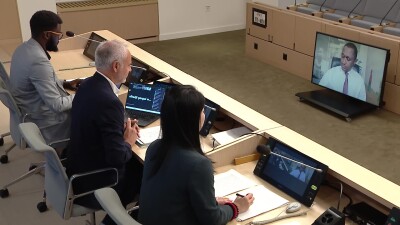
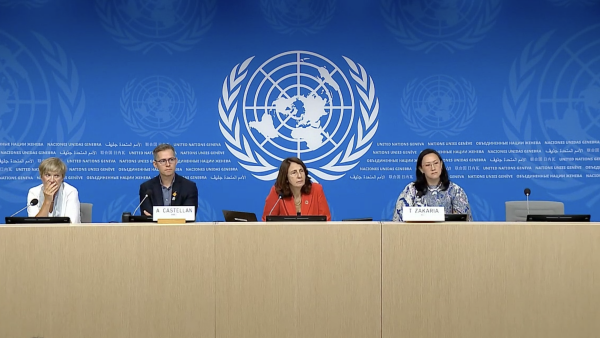
Update by the Expert Mechanism to Advance Racial Justice and Equality in Law Enforcement
1
1
1
Press Conferences | WIPO , WHO , UNICEF , UNHCR , IOM , WFP , FAO
WIPO Global Innovation Index 2026 launch and press conference, WHO Composition of influenza vaccines for the 2027 Southern Hemisphere flu season, UNICEF Yemen hunger and malnutrition; UNHCR Sudan displacement into Chad; IOM Ebola and population movements in DRC; WFP emergency food assistance in Nepal; and FAO food loss and waste.
2
1
2
Press Conferences | UNCTAD
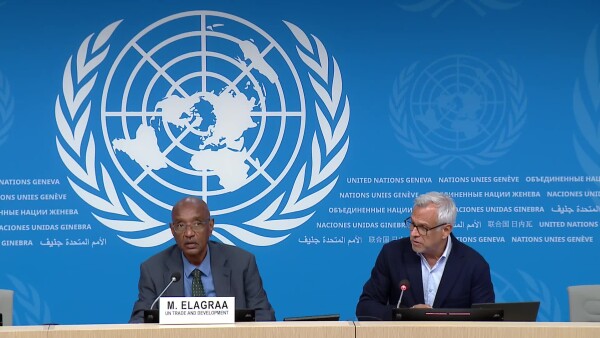
Gaza reconstruction needs reach $71.5 billion as Palestinian economy and public finances face severe strain. Latest UNCTAD report documents the loss of decades of development gains, economic collapse in Gaza and tightening economic constraints in the West Bank.
The report identifies three immediate priorities: transferring withheld Palestinian revenues, safeguarding the banking system and aligning reconstruction support with the documented scale of damage and economic losses.
1
1
1
Press Conferences | HRC
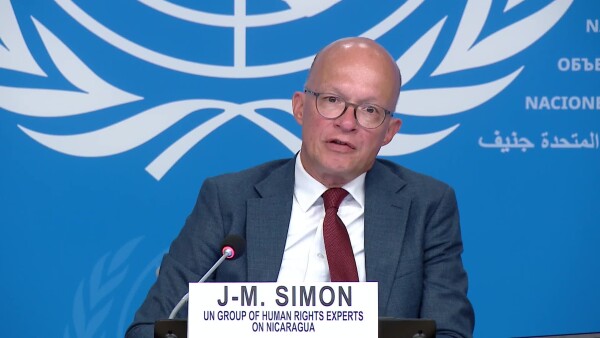
Press conference on the situation of human rights in Nicaragua by the UN Group of Human Rights Experts
1
1
1
Press Conferences | ITU , UNHCR , WHO , WMO
YEMEN - UNHCR: Escalating conflict in Yemen could fuel more displacement, refugee movement
CLIMATE - WHO / WMO: Health and Climate impact of El Niño
1
1
1
Press Conferences | HRC , OHCHR
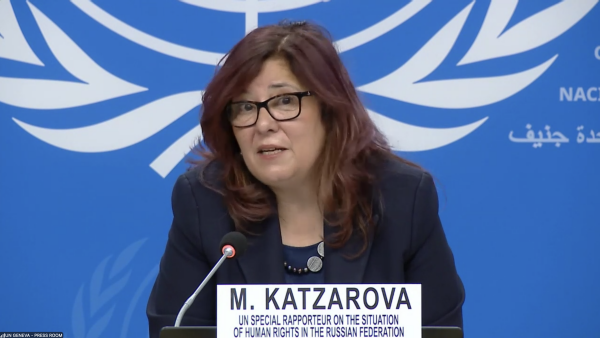
Mariana Katzarova discusses human rights in Russia as a UN Special Rapporteur.
1
1
1
Press Conferences | IOM , OHCHR , UN WOMEN , UNFPA , UNHCR , UNOPS , WHO
UN Geneva briefing: Yemen crisis worsens, urgent aid needed across multiple sectors.
1
1
1
Press Conferences | HRC
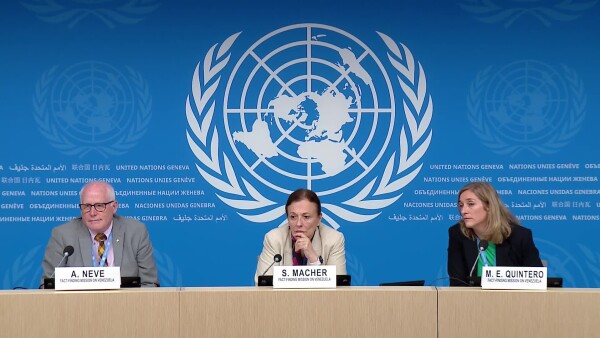
Press conference on the latest report of the Independent International Fact-Finding Mission on the Bolivarian Republic of Venezuela to the UN Human Rights Council
1
1
1
Press Conferences | OHCHR
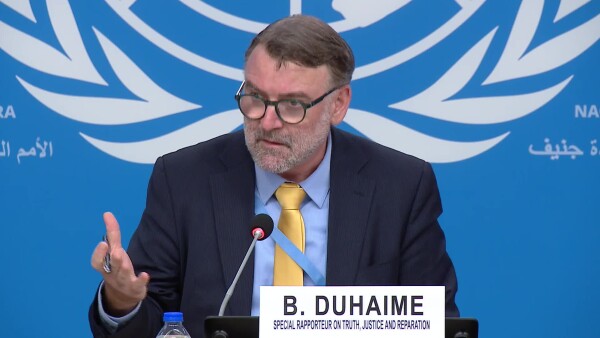
Victims Still Waiting: A Global Briefing on Transitional Justice Around the World
2
1
2
Edited News , Press Conferences | WMO
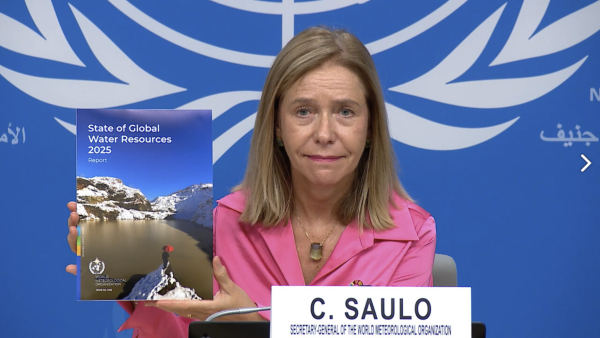
As world’s water reserves change, countries must prepare for a new reality: WMO
New data showing that rivers were at their lowest level for decades last year provides further evidence that the climate crisis is real and countries must act immediately to protect themselves from the increasing threat to communities and livelihoods, the UN World Meteorological Organization (WMO) said on Thursday.
The key findings from WMO’s State of Global Water Resources 2025 report covering the hydrological cycle and extreme events in the five-year period to last year:
- 2025 was one of driest years for river discharge in 35 years
- Past seven years have seen abnorfmal river flows
- Water storage on Earth’s land surface has decreased in past decade
- Widespread glacier loss across all regions for fourth consecutive year
- Asia and Africa are regions most affected by water-related disasters
- Water data availability has improved, but gaps remain in hard-hit areas
Highlighting the long-term decline in the Earth’s freshwater storage and glacier melt, WMO Secretary-General Celeste Saulo explained that the planet’s water reserves used to act as a planetary “savings account” that absorbed the occasional dry season, avoiding a water crisis. “One of the central stories of the 2025 report is what is happening to that savings account? And the simple answer is that we are depleting it,” she told journalists in Geneva.
Groundwater reserves are equally stretched and have been in decline since 2014, WMO’s report states, with nearly two-thirds of monitored wells worldwide showing levels lower than the historical norm and indicating a shift “further toward deficit…not recovery”.
“At the same time, we are seeing more water-related disasters,” Ms. Saulo said, while also stressing that the currently strengthening El Niño “will increase the risk of drought in some areas, and flooding in others”.
Glaciers disappearing
In 2025, for the fourth consecutive year, every major glaciated region on Earth lost ice mass, leading to short-term hazards including floods and long-term water insecurity, according to WMO.
Responding to a question about whether the changing global water cycle might have contributed to the deadly Nepal-China flooding disaster, Ms. Saulo explained that melting ice and rock was just one factor in the chain of events that ultimately sent a massive and deadly wall of water and debris downstream on 26 August, killing at least 1,367 people.
“You asked if it could happen again? Absolutely; the problem in this region is that there’s 63,700 glaciers at the last count,” she told a Press Conference in Geneva. “Even if you’re looking with remote sensing with satellites at these glaciers, you might see some faults, you might see some slight shifting, that does not mean necessarily catastrophic collapse. So, in order to plan for this, it’s very, very difficult. But the international community is looking very hard at ways in which we can bring people together to solve some of these monitoring issues.”
Data indicates that glaciers shrank between 2023 and 2025 with cumulative losses of 1,400 gigatonnes of water – or about one third of annual fresh water needs.
Every major glacier region on Earth lost ice for the fourth consecutive year.
“All 19 glacier regions around the globe lost ice; in Central Asia, Iceland, the Russian Arctic and western Canada and the United States, it was among the three worst years on record,” said Wayne Jenkinson, WMO’s Director of Hydrology and Cryosphere.
Some regions with smaller glaciers such as Central Europe, the Caucasus, the western Canada and the United States may already have reached “peak water”, Mr. Jenkinson warned.
“After this point, the glacier gives less meltwater each year simply because there is less ice left to melt. That matters for every community downstream that relies on water during hot, dry summers,” he explained.
Narelle van der Wel, WMO’s Head of Cryosphere Monitoring, Predictions and Services, stressed that while some further glacier loss is unavoidable, the eventual scale of the decline is not predetermined.
“Some glacier loss is inevitable, but total loss of glaciers is not yet inevitable,” she said, pointing to emissions reductions as central to limiting future losses.
Preparing for moving baselines
The report does not attribute every observed change to climate change alone. WMO says pressure on water resources and natural variability also contribute.
Mr. Jenkinson said governments need to prepare for “moving baselines” as historical patterns become less reliable.
“The situation 30 years ago is not where we are today,” he said. Countries, he added, need to prepare “for those changes that have really already arrived”.
ends