

The United Nations Office at Geneva
Multimedia Newsroom
PRESS BRIEFING BY THE UNITED NATIONS INFORMATION SERVICE
26 July 2022
Michele Zaccheo, Chief of the Radio, TV and Webcast Section at the United Nations Information Service in Geneva chaired the hybrid press briefing which was attended by a spokesperson and a representative of the World Health Organization.
Monkeypox
Tarik Jašarević, for the World Health Organization (WHO), reminded that on 23 July, WHO Director General had decided to determine the monkeypox outbreak a Public Health Emergency of International Concern (PHEIC), and to issue Temporary Recommendations to countries to implement a coordinated response, with the goals of stopping human-to-human transmission and protecting vulnerable groups.
Dr. Rosamund Lewis, Technical Lead on Monkeypox at the World Health Organization (WHO), said that the determination of a PHEIC constituted the highest level of global public health alert, and should enhance coordination, cooperation, and global solidarity. This outbreak could be stopped with the right strategies in the right groups.
Monkeypox could cause a range of signs and symptoms, including painful sores. Some people developed serious symptoms that needed care in a health facility. Those at higher risk for severe disease or complications included pregnant women, children, and immunocompromised persons.
WHO assessed the risk in the European region as high and at the global level as moderate considering this was the first time that many monkeypox cases and clusters were reported concurrently in many countries in widely disparate WHO geographical areas.
The Temporary Recommendations applied to different groups of States Parties, based on their epidemiological situation, patterns of transmission and capacities. Dr. Lewis stressed that countries with manufacturing capacity for smallpox and monkeypox diagnostics, vaccines or therapeutics should increase production and availability of medical countermeasures. Countries and manufacturers should work with WHO to ensure diagnostics, vaccines, therapeutics, and other necessary supplies were made available based on public health needs, solidarity and at reasonable cost to countries where they were most needed to support efforts to stop the onward spread of monkeypox.
Responding to numerous questions from journalists, Ms. Lewis said that the WHO was working with Member States and the European Union on releasing vaccines. WHO was also working with partners to determine a global coordination mechanism. A dashboard with regularly updated data on cases was available online. Mass vaccination was not required, but the WHO had recommended post-exposure vaccination. Vaccine sharing should be done according to public health needs, country by country and location by location. Anyone who had been exposed to someone with monkeypox should be vaccinated first, explained Dr. Lewis. Not all regions had the same epidemiology, she explained. Preventing stigma and discrimination ought to be avoided, as that would harm the response.
Some 81 children under the age of 17 were reported as having been infected globally thus far. Dr. Lewis explained that some 16.4 million vaccines were currently available in bulk but needed to be finished. The name “monkeypox” was already present in the International Classification of Diseases, she said, and a process had to be followed in order to potentially change its name. In the Democratic Republic of the Congo, where several thousand cases were suspected, the testing facilities were limited, and support needed to be provided in that regard. The global dashboard did not include suspected cases.
Dr. Lewis explained that historically smallpox/monkeypox vaccines had been very effective, but they were now more attenuated and could possibly be somewhat less effective. The countries producing vaccines were Denmark, Japan, and the United States. There had been no studies on compatibility of COVID-19 and monkeypox vaccines, she said. Administering different vaccines at the same time would mean boosting different parts of the immune system. The majority of cases were among young men, with the median age being 37. She reminded that after 1980 no country had administered smallpox vaccines, which were known to be very powerful and offer long-term immunity. The reproductive number had been under 1 for monkeypox in natural settings; the outbreaks tended not to be explosive. For men having sex with men or those with multiple partners, the reproductive number was higher. The current recommendation for persons with monkeypox was to isolate and not travel until they recovered; contact cases should be checking their temperature and monitoring possible other symptoms for the period of 9 to 21 days.
The current figure was around 16,000 confirmed cases globally; detailed numbers by country could be found at the dashboard. Dr. Lewis explained that the WHO regional offices played a critical role for the overall risk assessment. Responding to a question, Dr. Lewis said that the situation in Brazil was concerning, and the authorities should take notice of the PHEIC and the recommendations, and act accordingly, said Dr. Lewis in response to another question. The first countries to report cases had been the United Kingdom and Portugal, followed by Spain.
Announcements
Michele Zaccheo, for the United Nations Information Service (UNIS), informed that the Committee Against Torture was meeting this morning to discuss the follow-up to its concluding observations; follow-up to the individual communications it had received; and follow-up to reprisals against persons who had collaborated with the Committee.
The Human Rights Committee would meet on 27 July, at 10 am to end its 135th session. It would then issue its concluding observations on the reports of Hong Kong (China), Macau (China), Georgia, Ireland, Luxemburg, and Uruguay. The concluding observations, as well as the Committee’s recommendations to the six countries, would be published on the Committee’s website. The same day at 1:30 pm, there would be a hybrid press conference at which the Committee would present its findings on the political and civil rights on the countries and territories considered. Speakers would be Photini Pazartis, Chairperson, and Christopher Arif Bulkan, Vice chairperson.
Responding to a question on the missile attack against the Odesa port, Mr. Zaccheo said that UN Secretary-General Antonio Guterres had unequivocally condemned missile attacks earlier in the day on Ukraine's Odessa, a port that is key to a UN-brokered grain export deal between Russia and Ukraine. Full implementation of the deal by the Russian Federation, Ukraine and Turkey was imperative.
Similar Stories
1
1
1
Press Conferences | WMO , UNHCR , WHO , ILO
WMO: Greenhouse Gas Bulletin; UNHCR: As attacks intensify UNHCR urges support for war ravaged Ukrainians; WHO: Clinical trials in DRC: vaccines and beyond; ILO: New global and regional estimates on domestic work, informality and working conditions
1
1
1
Press Conferences | UN WOMEN , WFP , WHO
UN WOMEN: Sudan Women and girls one year after the fall of El Fasher; increasing drone attacks across the country; WFP: DRC - Ebola spreads to eighth DRC province as WFP delivers food, builds treatment centres and keeps supplies moving; WHO - Update on Ebola (Bundibugyo Virus Disease)
1
12
1
1
Press Conferences , Images | UNOG
Closing Press Conference following the Sixth Consultative Meeting on Enhancing Coordination of Peace Initiatives and Efforts in Sudan

2
17
1
2
Edited News , Press Conferences , Images | OCHA , WMO
Two UN agencies teamed up on Wednesday to issue an appeal for immediate assistance to help communities already being impacted by the strongest El Niño on record.
1
1
1
Press Conferences | CITES
Wildlife trade and conservation policy discussions at the 81st meeting of the CITES Standing Committee (SC81)
1
1
1
Press Conferences | UNHCR , UNCTAD , WMO , OCHA , UNICEF , WHO
UNHCR Hungary’s 1956 Refugee Crisis: 70 Years On, UNCTAD World Investment Forum 2026, Doha, WMO Greenhouse Gas Bulletin and Climate Update for COP31, OCHA Afghanistan: Malnutrition, Girls’ Education and Recovery, UNICEF Yemen: Child Malnutrition and Unsafe Water in Taiz, WHO Inequalities in Noncommunicable Diseases and Risk Factors
1
1
1
Press Conferences | UNHCR
End of UNHCR's 77th Annual Executive Committee (ExCom) meeting week
1
1
1
Press Conferences | UNICEF , IOM , UNHCR
UN Special Assistant to the Personal Envoy Office (SUDAN): Peace Initiatives and Efforts in Sudan; UNICEF: Dire situation of children in Gaza; IOM: Damaged Homes and Energy Attacks Risk Displacing Ukrainians for this winter; UNHCR: update on EXCOM week

1
1
1
Press Conferences | IOM , UNDRR
UN stresses importance of household preparedness for disaster risk reduction.
1
1
1
Statements , Press Conferences | OHCHR
1
1
1
Press Conferences | UNHCR , UNICEF , IFRC , OHCHR , UN WOMEN , IOM , OCHA , WHO
UNHCR – ExCom Meeting, UNICEF – Nepal Recovery, IFRC – Flash Floods, WHO – Mental Health, IOM – South Sudan Floods, OCHA – DRC Humanitarian aid, UNHCR – Sahel Displacement, UNICEF – Yemen Update, IOM – Gaza Shelter, UN Women – Gaza Women, OHCHR – Arrests and detentions of Syrians by Israeli force
2
1
2
Press Conferences | UNCTAD
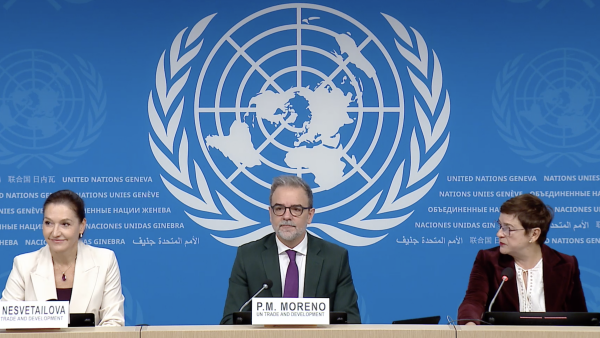
Presentation of the Trade and Developement Report 2026
Embargoed until 9 October 2026 at 11 a.m. (Geneva Time)
UNCTAD: UNCTAD’s flagship report finds that governments increasingly use industrial, trade, financial and technology policies to pursue economic and national security objectives. Market access and the ability to move into higher-value activities now depend more heavily on technology, finance and geopolitics.