

The United Nations Office at Geneva
Multimedia Newsroom
COVID outbreak in DPRK
Elizabeth Throssell, for the Office of the High Commissioner for Human Rights (OHCHR), said that the OHCHR was deeply concerned about the likely human rights impact of the first officially confirmed cases of COVID-19 in the Democratic People’s Republic of Korea, and the subsequent lockdowns imposed by the authorities. As of 16 May, 66 people were reported to have died of COVID-19; close to 664,000 people were reported to be undergoing a medical treatment due to fever. DPRK had very limited capacities to deal with this crisis as it lacked testing facilities, medicine and equipment.
Ms. Throssell reminded that the DPRK had closed its borders in January 2020 and restricted internal movement. The restrictions had further eroded the situation of human rights in the country. The latest restrictions would have dire consequences on those who had already been struggling to put food on the table. Those in detention were particularly at risk of infection, she warned. DPRK authorities were urged to ensure that all measures were proportionate and strictly in line with the human rights law.
Responding to questions, Ms. Throssell confirmed that there had been little engagement with the DPRK since the closure of the country’s borders in 2020. Freedom of movement was now severely restricted, following the outbreak of the disease. While governments had an obligation to protect public health, said Ms. Throssell, measures taken needed to be proportionate, specific and time bound in duration.
Full press release is here.
Fadéla Chaib, for the World Health Organization (WHO), referred to the WHO press release issued the previous day. WHO had offered its support to the government and the people of the DPRK in order to save lives. WHO had already supported the country to develop a COVID-19 vaccine deployment plan as well as aided the country with its national strategic preparedness and response plans.
More than 100,000 disappearances in Mexico
Elizabeth Throssell, for the Office of the High Commissioner for Human Rights (OHCHR), said that UN High Commissioner for Human Rights Michelle Bachelet today called on the Mexican authorities to step up efforts to ensure truth and justice for victims of disappearances, who now numbered more than 100,000, according to official data.
“The scourge of disappearances is a human tragedy of enormous proportions,” said Bachelet. “No effort should be spared to put an end to these human rights violations and abuses of extraordinary breadth, and to vindicate victims’ rights to truth, justice, reparation and guarantees of non-repetition.” Mexico had taken significant steps in this regard, acknowledged Ms. Throssell. In 2020, Mexico had recognized the competence of the UN Committee on Enforced Disappearances, which had had an opportunity to visit Mexico. The Committee had just issued a press release.
The High Commissioner also called on the authorities to place the families of those who have disappeared at the centre of their efforts, and to make the necessary resources available for investigations and searches to be effective. Tackling impunity was difficult, said Ms. Throssell, and emphasized that it was important for Mexico to implement all the recommendations by the Committee on Enforced Disappearances.
OHCHR press release can be found here.
Human Rights High Commissioner’s visit to China
Responding to questions on the visit of the UN Human Rights Chief to China, Elizabeth Throssell, for the Office of the High Commissioner for Human Rights (OHCHR), said that the advance team was still in China and now out of quarantine. The High Commissioner herself would be visiting Guangzhou and Xinjiang. The purpose of the trip was to raise a whole range of human rights issues with the Government of China. It was hoped that the visit would help build further engagement between the UN Human Rights Office and China. The High Commissioner would not need to quarantine upon her arrival, explained Ms. Throssell, and her visit would last six to seven days. Ms. Bachelet would be meeting several very senior Chinese officials. An end-of-mission statement was likely to be issued. The OHCHR report on the situation in Xinjiang would not be published before the High Commissioner’s visit, stated Ms. Throssell. China was expected to express its views on the report, which would be shared with the authorities.
Death penalty in Iran
Elizabeth Throssell, for the Office of the High Commissioner for Human Rights (OHCHR), stated that the OHCHR was deeply alarmed by the imminent execution in Iran of Swedish-Iranian doctor and academic Ahmedreza Djalali and urgently called on the Iranian authorities to halt the execution and revoke his death sentence.
Iranian authorities had announced on 16 May that while the execution currently scheduled to take place by 21 May might be postponed following a request from Djalali’s lawyers, “the verdict is final, and the execution will be carried out.” Use of the death penalty for espionage offences was incompatible with international human rights law, stressed Ms. Throssell.
More information is available here.
75th World Health Assembly
Fadéla Chaib, for the World Health Organization (WHO), informed that the 75th WHA would open at the Palais des Nations in Geneva on 22 May. On the opening day, the Assembly would hear from eight high-level speakers. The theme would be “Health for Peace. Peace for Health.” There were more than 70 issues on the agenda, including the appointment of the next WHO Director-General, which was likely to happen on 24 May. Also on the agenda would be sustainable financing, strengthening WHO’s preparedness for future health emergencies, as well as polio, and prevention of sexual abuse and harassment. A press release would be sent out today.
Announcements
Anne-Sophia Fisher, for the International Labour Organization (ILO), informed that on 23 May, the ILO would be launching the 9th edition of its Monitor on the World of Work. The Monitor tracked the impact of the COVID-19 pandemic on workers and businesses worldwide. This edition also looked at how the fallout from the pandemic was interacting with other global crises. An online press conference would be held on 23 May at 9:30 am, with the ILO’s Director-General, Guy Ryder, and the head of the team that compiled the Monitor, Sangheon Lee. The report and all associated materials would be under embargo until 12 noon CET on 23 May.
Fadéla Chaib, for the World Health Organization (WHO), said that today at 3 p.m. there would be a regular press conference on COVID-19 and other health issues.
At 5 p.m. Geneva time, WHO Europe would hold a press briefing, from Kyiv, on the health situation in Ukraine and WHO’s help. Speakers would be Hans Kluge, WHO Regional Director for Europe; Jarno Habicht, head of the WHO in Ukraine; and Doris Nitzan, WHO Regional Emergency Coordinator.
Jens Laerke, for the Office for the Coordination of Humanitarian Affairs (OCHA), said that Martin Griffiths, the UN Humanitarian Emergency Coordinator, would hold a press conference on 19 May at 3:30 p.m. He would speak of his recently concluded visit to Kenya and other current humanitarian issues.
Clare Nullis, for the World Meteorological Organization (WMO), informed that the State of the Global Climate 2021 would be presented at a press conference at Palais des Nations on 18 May. Petteri Taalas, the Secretary-General of the World Meteorological Organization would be joined by the report’s coordinator Omar Baddour. A video message by the UN Secretary-General would also be shared.
Speaking on behalf of the Food and Agriculture Organization (FAO), Rhéal LeBlanc informed that this week FAO would celebrate World Bee Day through a virtual event, under the theme ‘Bee Engaged: Celebrating the diversity of bees and beekeeping systems’. The event would raise awareness on the importance of the wide variety of bees and sustainable beekeeping systems, the threats and challenges they face and their contribution to livelihoods and food systems. More information and registration here.
In Geneva, the Permanent Mission of Slovenia, the Permanent Mission of Switzerland, the FAO Liaison Office, and the United Nations Office at Geneva would mark the day on 20 May at 11 a.m. with an event highlighting the importance of beekeeping as an opportunity for rural livelihood diversification, helping alleviate poverty, protect biodiversity and support food security. More information and registration here. Geneva’s landmark Jet d'Eau would be lit in yellow on the evening of 20 May.
On behalf of the World Trade Organization (WTO), Mr. LeBlanc said that the WTO members were holding "Fish Week", to intensify negotiations for a global deal to curb harmful fishing subsidies. The objective was to close remaining issues ahead of the 12th Ministerial Conference, which would take place from 12 to 15 June. The chair of the negotiations, Ambassador Santiago Wills of Colombia, would hold a press briefing in Room S3 at the WTO on 20 May at 2 p.m. to report on members' progress.
Mr. LeBlanc also informed that the Committee on the Rights of the Child was concluding this morning its review of the report of Cyprus.
The Conference on Disarmament would hold on 19 May the first public meeting of the second part of its 2022 session, under the presidency of Ambassador Juan Antonio Quintanilla Román (Cuba).
Finally, Mr. LeBlanc reminded that today was the World Telecommunication and Information Society Day, as well as the International Day against Homophobia, Biphobia and Transphobia, on which occasion the Secretary-General had issued a message.
The next Ciné-ONU event would be held at Cinérama Empire in Geneva on 18 May at 6:30 pm. The movie “All of Us” would be followed by a discussion. The entry would be free.
Similar Stories
1
1
1
Statements , Press Conferences | OHCHR
1
1
1
Press Conferences | UNHCR , UNICEF , IFRC , OHCHR , UN WOMEN , IOM , OCHA , WHO
UNHCR – ExCom Meeting, UNICEF – Nepal Recovery, IFRC – Flash Floods, WHO – Mental Health, IOM – South Sudan Floods, OCHA – DRC Humanitarian aid, UNHCR – Sahel Displacement, UNICEF – Yemen Update, IOM – Gaza Shelter, UN Women – Gaza Women, OHCHR – Arrests and detentions of Syrians by Israeli force
2
1
2
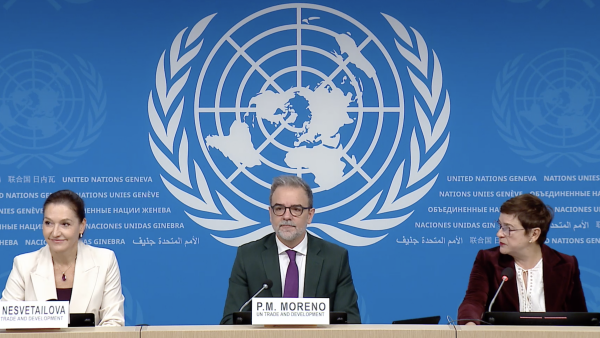
Press Conferences | UNCTAD
Presentation of the Trade and Developement Report 2026
Embargoed until 9 October 2026 at 11 a.m. (Geneva Time)
UNCTAD: UNCTAD’s flagship report finds that governments increasingly use industrial, trade, financial and technology policies to pursue economic and national security objectives. Market access and the ability to move into higher-value activities now depend more heavily on technology, finance and geopolitics.
1
1
1
Press Conferences | UPU
Release of the State of the Postal Sector Report 2026
1
1
1
Press Conferences | IOM , ITU , UNECE , UNICEF , WHO , WMO
UNICEF: Ebola, DRC - children orphans or separating them from parents and caregivers; IOM: Humanitarian needs in Djibouti amid arrivals from Yemen and increased migrant movements; WHO: Darfur, scale of health needs far exceeds available resources; WMO co-sponsored Global Heat Forum, Bangkok, monthly Global Seasonal Climate Update; UNECE: UN Forum of Mayors; ITU Plenipotentiary Conference 2026; WHO: child and adolescent obesity guidelines and new global roadmap to tackle pregnancy hypertension, a leading cause of maternal mortality
1
1
1
Press Conferences | OCHA , UN WOMEN , UNHCR , WFP , WHO , WTO , UNEP
OCHA – $160M CERF allocation to 12 underfunded crises; UNHCR – 5.8M refugee children remain out of school amid funding cuts; UN Women – Middle East escalation and food security among women/girls; WHO – Gaza supplies and overall situation; WFP – Yemen food insecurity and impact on global hunger ; UNEP - First International Conference of the Global Framework on Chemicals in Geneva | 16-20 November 2026
1
1
1
Press Conferences | UNHCR , WHO
Yemen's health system nears collapse amid conflict, causing rising casualties and medicine shortages.
1
1
1
Press Conferences | HRC
Update by the Expert Mechanism to Advance Racial Justice and Equality in Law Enforcement
1
1
1
Press Conferences | WIPO , WHO , UNICEF , UNHCR , IOM , WFP , FAO
WIPO Global Innovation Index 2026 launch and press conference, WHO Composition of influenza vaccines for the 2027 Southern Hemisphere flu season, UNICEF Yemen hunger and malnutrition; UNHCR Sudan displacement into Chad; IOM Ebola and population movements in DRC; WFP emergency food assistance in Nepal; and FAO food loss and waste.
2
1
2
Press Conferences | UNCTAD
Gaza reconstruction needs reach $71.5 billion as Palestinian economy and public finances face severe strain. Latest UNCTAD report documents the loss of decades of development gains, economic collapse in Gaza and tightening economic constraints in the West Bank.
The report identifies three immediate priorities: transferring withheld Palestinian revenues, safeguarding the banking system and aligning reconstruction support with the documented scale of damage and economic losses.
1
1
1
Press Conferences | HRC
Press conference on the situation of human rights in Nicaragua by the UN Group of Human Rights Experts
1
1
1
Press Conferences | ITU , UNHCR , WHO , WMO
YEMEN - UNHCR: Escalating conflict in Yemen could fuel more displacement, refugee movement
CLIMATE - WHO / WMO: Health and Climate impact of El Niño