

The United Nations Office at Geneva
Multimedia Newsroom
Press Conferences | OHCHR , UNHCR , WHO , UNITED NATIONS , WFP , UNCTAD , ILO , WMO , IOM , UNDP
Bi-Weekly Press Briefing 11March 2022
War in Ukraine
Matthew Saltmarsh, for the United Nations Refugee Agency (UNHCR), connecting from Rzeszów, Poland, said that the UNHCR had significantly stepped up its response in Ukraine and the neighbouring countries. There were at least two million internally displaced people, with more than 12 million people affected by the conflict; the total number of Ukrainian refugees had just passed 2.5 million.
Access to the heavily affected areas, such as Mariupol and Kharkiv, remained limited because of the ongoing hostilities. UNHCR pleaded, once again, for the respect for international humanitarian law and expressed gratitude for the neighbouring countries for keeping their borders open. UNHCR had intensified its activities in central and western Ukraine, where needs were also growing, and the access was less limited.
Inside Ukraine, UNHCR was working closely with authorities and partners to establish and expand reception capacity for IDPs, particularly in Lviv, Ivano-Frankivsk, Vinnytsia, Uzhgorod, Chernivtsi, and other localities and to provide key protection services.
Many shops in Ukraine were now accepting only cash payments, and UNHCR was scaling up its cash programme as a result. Outside of Ukraine, UNHCR commended the immense solidarity shown by host governments, communities, and local humanitarian partners. Emergency cash programmes were being rolled out in the neighbouring countries; the first families in Warsaw would be receiving cash distributions today.
More details available here.
Responding to questions, Mr. Saltmarsh confirmed that volunteers from across Europe were coming to the Polish-Ukrainian border, collecting refugees, and taking them to their home countries. He specified that the emergency cash distribution programme was moving very fast; in Poland, for example, the amount given was equivalent to what would be provided by Polish welfare services; this was supposed to serve as a stopgap, intermediary measure. The planning figure of having four million refugees might need to be revised, said Mr. Saltmarsh, and the appeals might need to be accordingly scaled up. UNHCR was working with governments in all neighbouring countries, he specified, stressing that help from any country outside of the European Union, including the United Kingdom, which wanted to step in and help, would be most welcome. UNHCR was desperately hoping that a safe path out of Mariupol would be provided. Most UNHCR staff were in the west part of the country, but some remained in central Ukraine, Mr. Saltmarsh informed.
Tarik Jašarević, for the World Health Organization (WHO), connecting from Lviv in Ukraine, stressed that there were reports today that the psychiatric institute in Kharkiv had been attacked. If proved true, that would be yet another attack against a health care facility in Ukraine. WHO strongly condemned all attacks against health care institutions, which was a flagrant violation of international humanitarian law. These had to stop. Twenty-six such attacks had been confirmed by the WHO, resulting in 12 deaths, including two health workers, and 34 injuries; updated information could be found on the WHO’s dashboard.
Five metric tons of surgical kits sent to Kyiv were now being distributed; more supplies were being sent to the east of Ukraine. WHO was also sending supplies for communicable and non-communicable diseases to neighbouring countries, including COVID-19 kits to Moldova.
In response to questions, Mr. Jašarević reminded that the WHO was regularly in contact with its Member States regarding lab safety, providing public health advise, while applying a risk-based approach. In case of a threat, there was a protocol on how to dispose safely of pathogens to avoid any accidental spills. The same regular work had been done with Ukraine. WHO had no mandate or expertise to analyze who attacked health facilities using which weapons. The more the war went on, the less opportunities to provide health care there would be for local people.
Elizabeth Throssell, for the Office of the High Commissioner for Human Rights (OHCHR), said the OHCHR had recorded 549 civilians killed and 957 injured, as of midnight on 9 March.
She stressed that civilians were being killed and maimed in what appeared to be indiscriminate Russian attacks. OHCHR had spoken to different sources in Mariupol, who had confirmed that the hospital had been clearly marked and working as such when it had been attacked.
Cluster munition attacks had been observed in several populated areas, which was incompatible with the international humanitarian law principles governing the conduct of hostilities.
OHCHR reminded the Russian authorities that direct attacks against civilian objects were prohibited under international humanitarian law and might amount to war crimes. OHCHR also objected to the arbitrary arrest of those civilians who peacefully protested the Russian invasion. In addition, prisoners of war had to be treated humanely and protected from torture.
Answering questions from the media, Ms. Throssell said Russian forces were launching artillery strikes and missiles against civilian areas. While the OHCHR could not attribute responsibility for each individual attack against health care, such attacks ought to be viewed in this broader context.
On another question, Ms. Throssell said that Meta’s announcement to lift some restrictions on hate speech against Russian officials and soldiers was a matter of concern, and the OHCHR would be seeking a clarification from Meta. Ms. Throssell once again confirmed that the maternity ward in Mariupol had been a functioning hospital, with patients in it, at the time of the attack.
OHCHR briefing note available here.
Responding to a question, Paul Dillon, for the International Organization for Migration (IOM), could not provide a specific number of third-country nationals remaining in Ukraine, but said that, as of this morning, 116,000 third-country nationals had fled Ukraine. IOM was helping many of those people to return to their home countries.
Drought in Somalia
Boris Cheshirkov, for the United Nations Refugee Agency (UNHCR), said that the UNHCR was scaling up assistance to thousands of people displaced by severe drought in Somalia following three consecutive failed rainy seasons that have decimated crops and livestock.
People’s coping mechanisms had been eroded, forcing thousands to flee their homes in search of humanitarian assistance including food, shelter, and safe drinking water. In the first week of March alone, more than 17,000 people in the country’s southern Bay region had been internally displaced by the drought, joining tens of thousands of people similarly displaced across the country between January and February this year. If the current trend held, UNHCR estimates that, in 2022 alone, half a million Somalis would likely be displaced before the end of March.
In 2022, UNHCR required USD 157.5 million to deliver critical aid and protection to about 2.9 million internally displaced people in Somalia, 40,000 refugee returnees, some 31,000 refugees and asylum seekers, and up to 15,000 new arrivals from Ethiopia and other countries. As of 1 March 2022, only 5 per cent of that amount had been received.
UNHCR briefing note is here.
Mr. Cheshirkov, responding to a question, said that, while attention was rightly being given to Ukraine, tens of millions of people around the world were also facing horrendous situations, including in Somalia. Funding remained a substantive issue for many crises. Somalia was an example of a crisis where conflict and climate change converged. The climate crisis continued to accelerate, and the consequences of our inaction would be harshest on the most vulnerable.
Clare Nullis, for the World Meteorological Organization (WMO), added that the WMO regional center in Africa believed that the outlook for most parts of the Horn of Africa was relatively good. The problem was that there was an accumulated rain deficit, so even if the upcoming rainy season was good, it still did not mean that Somalia would rapidly recuperate from three dry years.
Tomson Phiri, for the World Food Programme (WFP), said the consequences of the conflict in Ukraine were being felt and triggering collateral hunger across the world. Ukraine and Russia counted 30 per cent of global wheat exports, 20 per cent of global maze exports, and 76 per cent of sunflower supplies. This would also affect the possibility of the WFP to buy food. A press conference with WFP experts would be organized, he said. Mr. Phiri reiterated that one rainy season in the Horn of Africa would not be enough to erase the effects of the previous dry years.
High Commissioner Bachelet’s visit to Afghanistan
Elizabeth Throssell, for the Office of the High Commissioner for Human Rights (OHCHR), responding to questions on Afghanistan, said that the High Commissioner unequivocally condemned the attacks on polio workers in the country.
She added that the High Commissioner had made a brief visit to Afghanistan, and one of the focuses of her discussion with the de facto authorities had been on girls’ access to education, which was paramount for the future of the country.
Announcements
Sarah Bel, for the United Nations Development Programme (UNDP), informed that the Swiss Federal Office for the Environment and UNDP would be launching today a partnership to deploy USD 42 million to boost private climate investments to advance socio-economic development in developing countries, while supporting Switzerland to reduce greenhouse gas emissions generated by its government operations. This new agreement, which would be the first of its kind for UNDP, would be active until 2031. Initially, it would support energy access through solar power in Vanuatu and climate-smart agriculture in Ghana, with the possibility of supporting additional projects and countries.
Rosalind Yarde, for the International Labour Organization (ILO), that the 344th session of the ILO Governing Body would open on 14 March and run until 26 March. The meeting would elect the new Director-General of the organization, among other agenda items. Hearings with the five candidates for the next Director-General would be held in private on 14 March and the vote would take place on 25 March, when the results would be announced. The new Director-General would commence his or her term on 1 October 2022.
Catherine Huissoud, for the United Nations Conference on Trade and Development (UNCTAD), said that UNCTAD Secretary-General would make a statement on the situation in Ukraine today. On 23 March, UNCTAD would hold a press conference to present findings on the impact of the war in Ukraine on global economy.
Rhéal LeBlanc, for the United Nations Information Service (UNIS), informed that the seventh session of the Small Body of the Syrian Constitutional Committee would be meeting in closed sessions in Geneva from 21 to 25 March. A press briefing with UN Special Envoy for Syria, Geir Pedersen, was tentatively scheduled for 4 pm on 20 March, in Tempus 2.
The Conference on Disarmament would announce at a later stage the date of its next plenary public meeting.
The Human Rights Committee, in its 134th session, was concluding this morning its review of the report of Cambodia.
The Committee on the Rights of Persons with Disabilities, in its 26th session, would begin this afternoon its review of the report of Venezuela.
Similar Stories
1
1
1
Press Conferences | WMO , UNHCR , WHO , ILO
WMO: Greenhouse Gas Bulletin; UNHCR: As attacks intensify UNHCR urges support for war ravaged Ukrainians; WHO: Clinical trials in DRC: vaccines and beyond; ILO: New global and regional estimates on domestic work, informality and working conditions
1
1
1
Press Conferences | UN WOMEN , WFP , WHO
UN WOMEN: Sudan Women and girls one year after the fall of El Fasher; increasing drone attacks across the country; WFP: DRC - Ebola spreads to eighth DRC province as WFP delivers food, builds treatment centres and keeps supplies moving; WHO - Update on Ebola (Bundibugyo Virus Disease)
1
12
1
1
Press Conferences , Images | UNOG
Closing Press Conference following the Sixth Consultative Meeting on Enhancing Coordination of Peace Initiatives and Efforts in Sudan

2
17
1
2
Edited News , Press Conferences , Images | OCHA , WMO
Two UN agencies teamed up on Wednesday to issue an appeal for immediate assistance to help communities already being impacted by the strongest El Niño on record.
1
1
1
Press Conferences | CITES
Wildlife trade and conservation policy discussions at the 81st meeting of the CITES Standing Committee (SC81)
1
1
1
Press Conferences | UNHCR , UNCTAD , WMO , OCHA , UNICEF , WHO
UNHCR Hungary’s 1956 Refugee Crisis: 70 Years On, UNCTAD World Investment Forum 2026, Doha, WMO Greenhouse Gas Bulletin and Climate Update for COP31, OCHA Afghanistan: Malnutrition, Girls’ Education and Recovery, UNICEF Yemen: Child Malnutrition and Unsafe Water in Taiz, WHO Inequalities in Noncommunicable Diseases and Risk Factors
1
1
1
Press Conferences | UNHCR
End of UNHCR's 77th Annual Executive Committee (ExCom) meeting week
1
1
1
Press Conferences | UNICEF , IOM , UNHCR
UN Special Assistant to the Personal Envoy Office (SUDAN): Peace Initiatives and Efforts in Sudan; UNICEF: Dire situation of children in Gaza; IOM: Damaged Homes and Energy Attacks Risk Displacing Ukrainians for this winter; UNHCR: update on EXCOM week

1
1
1
Press Conferences | IOM , UNDRR
UN stresses importance of household preparedness for disaster risk reduction.
1
1
1
Statements , Press Conferences | OHCHR
1
1
1
Press Conferences | UNHCR , UNICEF , IFRC , OHCHR , UN WOMEN , IOM , OCHA , WHO
UNHCR – ExCom Meeting, UNICEF – Nepal Recovery, IFRC – Flash Floods, WHO – Mental Health, IOM – South Sudan Floods, OCHA – DRC Humanitarian aid, UNHCR – Sahel Displacement, UNICEF – Yemen Update, IOM – Gaza Shelter, UN Women – Gaza Women, OHCHR – Arrests and detentions of Syrians by Israeli force
2
1
2
Press Conferences | UNCTAD
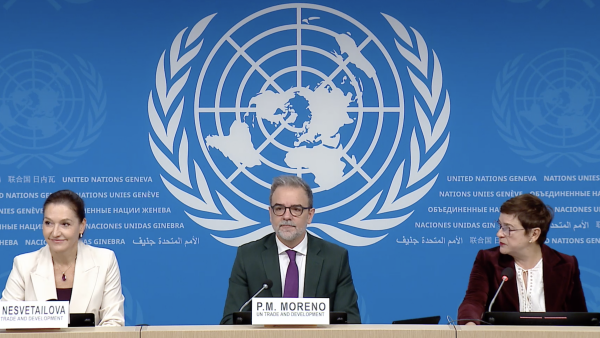
Presentation of the Trade and Developement Report 2026
Embargoed until 9 October 2026 at 11 a.m. (Geneva Time)
UNCTAD: UNCTAD’s flagship report finds that governments increasingly use industrial, trade, financial and technology policies to pursue economic and national security objectives. Market access and the ability to move into higher-value activities now depend more heavily on technology, finance and geopolitics.